
When someone searches on Google for a product, service, or answer, thousands or even millions of web pages may be relevant to that search. Yet only a small number appear on the first page.
So, how does Google decide which websites should appear first?
For Chennai businesses trying to improve their online visibility, understanding the basics of search rankings is important. You do not need to understand every technical detail of Google's algorithms, but knowing what search engines look for can help you make better decisions about your website, content, and overall SEO strategy.
Search engines generally try to provide users with pages that are relevant, useful, accessible, and trustworthy for their searches.
This guide explains how that process works and what Chennai businesses can do to improve their chances of appearing in relevant search results.
First, How Does Google Find Your Website?
Before a page can rank, Google first needs to discover and understand it.
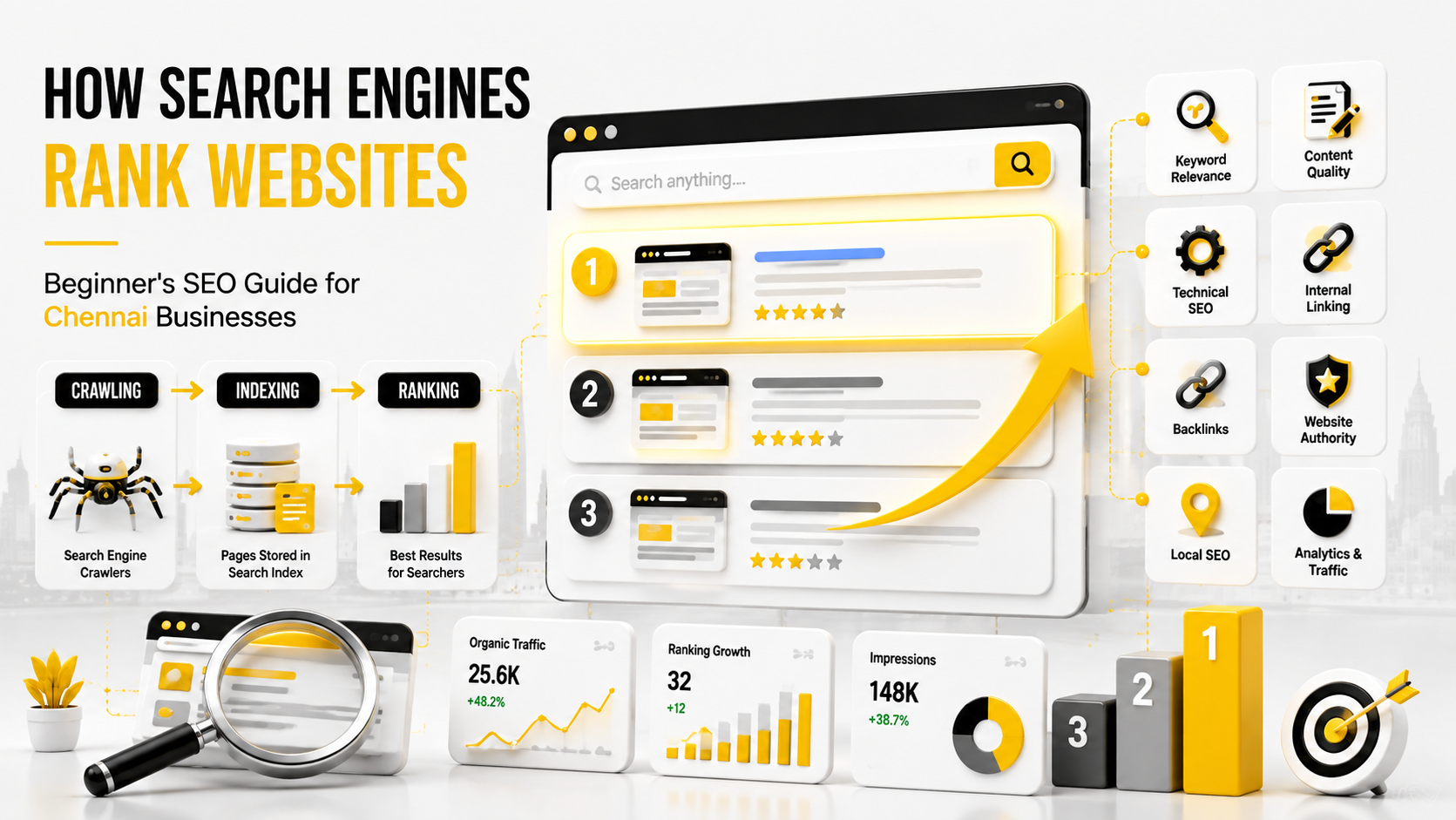
The process can be simplified into three stages:
Crawling → Indexing → Ranking
Each stage plays a different role.
Crawling
Search engines use automated programs commonly called crawlers or bots to discover pages across the web.
They find pages through links, sitemaps, and previously discovered URLs.
For example, when you publish a new blog and link to it from another page on your website, search engines may follow that internal link and discover the new URL.
Indexing
After discovering a page, Google processes its content and determines whether it should be included in its search index.
Being crawled does not automatically guarantee indexing.
Problems such as duplicate content, incorrect canonical tags, noindex directives, poor-quality pages, inaccessible resources, or other technical issues can affect whether a page is indexed.
Ranking
Once a page is eligible to appear in search results, Google's systems evaluate it against relevant searches.
The position can vary depending on the query, user intent, location, competition, content, website signals, and many other factors.
This means:
Indexed ≠ Ranked
A page appearing in Google's index does not mean it will automatically rank on the first page.
How Do Search Engines Decide Which Pages Should Rank?
There is no single factor that determines rankings.
Search engines evaluate many signals to determine which pages are most useful for a particular query.
Rather than trying to optimize for one mysterious “ranking factor,” businesses should focus on several fundamental areas.
1. Search Intent Comes First
One of the most important concepts in SEO is search intent.
Search intent simply means:
What is the person actually trying to accomplish with this search?
Consider these searches:
“what is SEO”
“SEO checklist”
“SEO services in Chennai”
Although all four relate to SEO, the intention behind each search is different.
Someone searching “what is SEO” probably wants information.
Someone searching “SEO services in Chennai” may be evaluating companies that can help with SEO.
If your page does not match what users expect from the search, simply repeating the keyword multiple times is unlikely to make the page competitive.
Before creating a page, ask:
What information would genuinely satisfy someone making this search?
That question should influence the entire page.
2. Content Relevance Helps Google Understand Your Page
Search engines need to understand what a page is about.
Keywords still play a role, but modern SEO is much broader than placing an exact phrase repeatedly throughout a page.
A useful page usually covers the main topic and closely related questions naturally.
For example, a comprehensive page about SEO might discuss:
-
keyword research
-
search intent
-
on-page SEO
-
technical SEO
-
internal linking
-
content quality
-
backlinks
-
local SEO
-
website performance
-
measurement
This provides much more context than repeating “SEO” in every paragraph.
Your title, headings, body content, internal links, image alt text, and metadata can all help search engines understand the subject of the page.
The goal should be clarity, not keyword density.
3. Content Quality Can Influence Search Performance
Publishing more content does not automatically create better rankings.
A useful article should provide something valuable to the reader.
Before publishing, consider whether the content:
-
answers the main question clearly
-
provides enough detail
-
avoids unnecessary repetition
-
uses accurate information
-
is easy to understand
-
adds practical examples
-
is written primarily for people rather than search engines
For businesses, this is particularly important.
A potential customer may discover your company through a blog before ever visiting a service page.
Helpful content therefore serves two purposes:
Search visibility + customer trust
A well-written article can introduce your expertise while helping readers solve a real problem.
4. On-Page SEO Provides Important Context
On-page SEO involves optimizing the elements within an individual webpage.
Important elements include:
Page Title
The title should clearly communicate what the page is about.
Main Heading
The H1 should accurately describe the primary subject of the page.
Subheadings
H2 and H3 headings help organize information and make longer pages easier to understand.
URL
URLs should generally be simple and descriptive.
For example:
/how-search-engines-rank-websites
is easier to understand than:
/blog?id=928374
Meta Description
A meta description does not need to be stuffed with keywords. It should encourage relevant searchers to visit the page by accurately explaining what they will find.
Images
Relevant images can improve the user experience. Descriptive file names and appropriate alt text can also provide useful context.
Good on-page SEO makes a page easier for both users and search engines to understand.
5. Internal Links Help Connect Your Website
Internal links connect one page of your website to another.
They are one of the most practical SEO elements businesses can control.
Suppose you have:
-
a main SEO service page
-
an article about technical SEO
-
an article explaining how long SEO takes
-
an article about local SEO
-
an article explaining Google rankings
These pages should not exist as isolated pieces of content.
Relevant internal links can connect them into a logical topic structure.
For example, someone reading this beginner's guide may eventually want professional help improving their website.
At that point, a contextual link to your SEO services in Chennai page makes sense because it gives the reader a useful next step.
Internal links can also help search engines discover pages and understand relationships between different sections of a website.
6. Website Authority and Backlinks Matter
A backlink is a link from another website to yours.
Search engines can use links as one of many signals when evaluating pages and websites.
However, not every backlink has the same value.
One relevant link from a legitimate website can be more meaningful than large numbers of artificial links created only to manipulate rankings.
Businesses should focus on earning or building legitimate mentions through useful resources, industry participation, original insights, partnerships, directories where appropriate, digital PR, and genuinely valuable content.
Avoid treating SEO as a competition to collect the largest possible number of links.
Relevance and quality matter more than raw backlink counts.
7. Technical SEO Can Affect Crawling and Indexing
A website can have excellent content and still experience search visibility problems because of technical issues.
Technical SEO helps search engines access, process, and understand your website efficiently.
Common areas to review include:
-
crawlability
-
indexing
-
XML sitemaps
-
robots.txt
-
canonical tags
-
redirects
-
broken links
-
duplicate URLs
-
mobile usability
-
HTTPS
-
structured data
-
website architecture
-
page performance
For example, if an important service page accidentally contains a noindex directive, improving the content will not solve the core problem.
The technical issue needs to be fixed first.
This is why a proper SEO audit should evaluate both content and technical factors.
8. Page Experience Still Matters for Users
SEO should not stop when someone clicks your search result.
Think about what happens next.
If the website takes too long to load, is difficult to use on a phone, contains intrusive elements, or makes important information difficult to find, users may leave.
A good website experience includes:
-
mobile-friendly layouts
-
readable typography
-
clear navigation
-
useful content structure
-
accessible pages
-
reasonable loading performance
-
clear calls to action
Some page-experience signals may be used directly or indirectly within search systems, but the larger point is simple:
A website that frustrates users is unlikely to support strong business results, regardless of rankings.
9. Trust and Experience Strengthen Your Content
For business websites, readers often want evidence that the company understands the subject it is discussing.
You can demonstrate credibility through:
-
real business information
-
clear author information
-
genuine customer reviews
-
case studies
-
project examples
-
transparent contact details
-
original insights
-
first-hand experience
-
accurate claims
-
clear service information
This is especially important for service businesses.
Anyone can publish an article claiming to be an expert. Showing evidence of real experience makes the content more useful and credible.
10. Local SEO Works Differently From Traditional Organic SEO
For Chennai businesses serving local customers, ranking a website is only part of the search visibility opportunity.
Google may also display local results and map listings for location-sensitive searches.
For example:
“SEO company near me”
“digital marketing agency in Velachery”
“web development company Chennai”
“Google Ads agency near me”
Local visibility can be influenced by factors related to relevance, distance, and prominence.
Businesses should maintain an accurate Google Business Profile and ensure that important details such as their business name, category, website, phone information, operating hours, services, photos, and customer reviews are properly maintained.
Your website and Google Business Profile should support each other rather than being treated as unrelated assets.
Why Does One Page Rank While Another Doesn't?
Imagine two Chennai companies publish pages targeting the same topic.
Company A publishes a short page containing the target keyword many times.
Company B publishes a comprehensive page that matches search intent, explains the topic clearly, provides practical examples, links to supporting resources, has good technical foundations, and demonstrates genuine expertise.
Which page provides more value to the searcher?
SEO is not simply about placing a keyword in the right locations.
Search engines are trying to identify pages that best satisfy the query.
This is why businesses should stop asking:
“How many times should I use my keyword?”
and start asking:
“Is this genuinely one of the most useful pages someone could find for this search?”
That shift in thinking can dramatically improve content strategy.
How Long Does It Take for a Website to Rank?
There is no universal SEO timeline.
Some pages may gain visibility relatively quickly, while highly competitive searches can require much longer.
Results depend on factors such as:
-
existing website authority
-
competition
-
technical condition
-
content quality
-
search intent
-
backlinks
-
internal linking
-
website history
-
local competition
-
how frequently the website is improved
For a newer Chennai business website competing against established domains, expecting every important keyword to reach Google's first page within a few weeks is usually unrealistic.
SEO should be treated as an ongoing process of improving relevance, quality, technical health, and authority.
How Should Chennai Businesses Approach SEO?
Instead of starting with hundreds of keywords, begin with your business goals.
Identify the services that matter most.
Then research how potential customers search for those services.
A simple strategy could look like this:
Step 1: Identify your highest-value services.
Step 2: Research relevant search queries and intent.
Step 3: Build strong service pages.
Step 4: Fix technical SEO issues.
Step 5: Create supporting content around customer questions.
Step 6: Connect related pages through internal links.
Step 7: Strengthen local search visibility.
Step 8: Build relevant authority and mentions.
Step 9: Track performance through Google Search Console and analytics.
Step 10: Improve pages based on actual search data.
This creates a much stronger foundation than publishing random blogs and hoping one of them ranks.
SEO Services in Chennai: When Should a Business Consider Professional Help?
Some SEO tasks can be handled internally, especially when a company has marketing professionals who understand content and website management.
Professional support may become useful when:
-
important pages are not being indexed
-
rankings remain stagnant despite consistent work
-
organic traffic is declining
-
the website has significant technical problems
-
competitors consistently outrank the business
-
the company is entering a competitive market
-
the internal team lacks time for continuous optimization
-
traffic is increasing but enquiries are not
When evaluating SEO services in Chennai, businesses should look beyond promises about rankings.
A strong SEO strategy should connect technical improvements, content, search intent, authority, local visibility, and conversions.
The goal should not simply be “more rankings.”
The real objective is attracting relevant search traffic that contributes to business growth.
How Tecminion Approaches SEO for Chennai Businesses
At Tecminion, we look at SEO as a combination of technical foundations, useful content, search intent, website structure, local visibility, and continuous improvement.
Instead of focusing only on keyword positions, we examine how people discover the website and what happens after they arrive.
That can include reviewing technical SEO issues, identifying valuable search opportunities, improving service pages, developing supporting content, strengthening internal links, improving local SEO, and monitoring performance.
The appropriate strategy depends on the business, its competition, its website, and its goals.
Final Thoughts
Search engines may use sophisticated systems to rank websites, but the fundamental objective is easier to understand:
Help users find useful, relevant and trustworthy information for their searches.
For Chennai businesses, that means SEO should not revolve around tricks or excessive keyword repetition.
Build pages that answer real questions.
Keep your website technically accessible.
Connect related content.
Demonstrate genuine expertise.
Improve your local presence.
Earn relevant authority.
And continuously evaluate what is actually working.
When these elements work together, your website has a much stronger foundation for sustainable organic search growth.
If your business is struggling with indexing, rankings, organic traffic, or local search visibility, Tecminion's SEO services in Chennai can help identify the gaps and build a practical strategy around your business goals.
Frequently Asked Questions
How does Google rank websites?
Google uses automated ranking systems that consider many signals to determine which pages are most relevant and useful for a particular search. Relevance, content quality, links, usability, context, and other factors can influence which results appear.
Does using a keyword many times improve rankings?
Not necessarily. Repeating a keyword excessively can make content unnatural and does not guarantee better rankings. The page should primarily satisfy search intent and cover the topic clearly.
Why is my website indexed but not ranking?
Indexing only means that Google has included the page in its search index. Ranking depends on competition, relevance, content, authority, technical factors, search intent, and other signals.
Are backlinks still important for SEO?
Links can still contribute to how search engines understand authority and relevance, but quality matters. Businesses should focus on legitimate and relevant links rather than generating large volumes of low-quality backlinks.
How long does SEO take in Chennai?
There is no fixed timeline. Results depend on your website, competition, target keywords, technical condition, content, authority, and existing search visibility. Competitive searches generally require sustained optimization.
Should Chennai businesses invest in local SEO?
Businesses serving customers in specific locations can benefit significantly from local SEO. An optimized Google Business Profile, genuine reviews, accurate business information, locally relevant website content, and a strong website can improve local search visibility.