
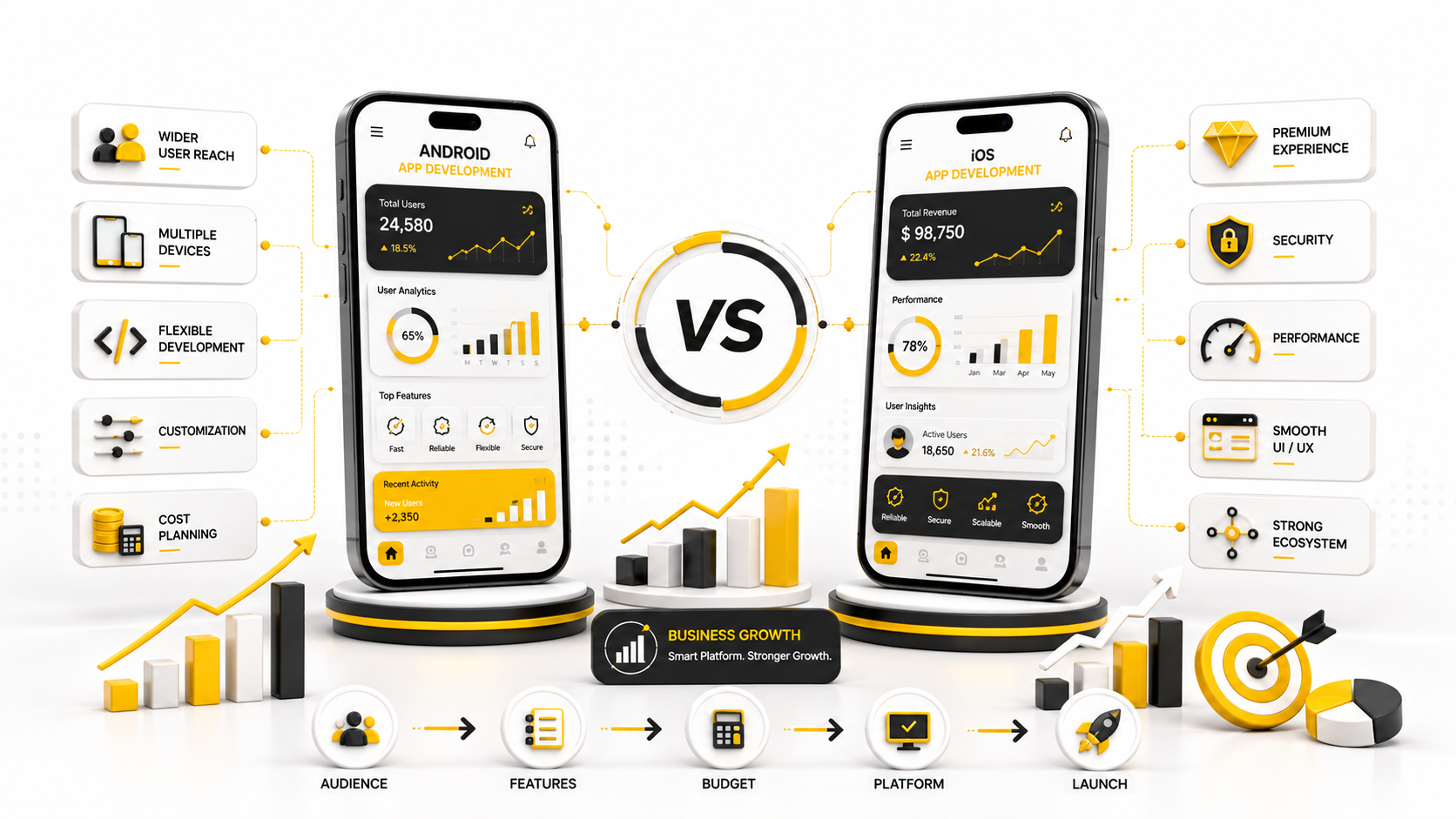
Choosing to build a mobile app is an important step for any growing business. But once you decide to invest in an app, another question usually comes up:
Should you build an Android app, an iOS app, or both?
There is no single answer that works for every business. The right choice depends on your customers, budget, business model, required features, and long-term plans.
For businesses in Chennai, this decision is especially important because customers use mobile apps for everything from shopping and food delivery to healthcare, education, real estate, bookings, and professional services.
In this guide, we will compare Android and iOS app development from a business perspective and help you decide which platform makes more sense for your project.
Android vs iOS: What Is the Basic Difference?
Android and iOS are the two major mobile operating systems businesses typically consider when developing an app.
Android is used by smartphones from a wide range of manufacturers and gives businesses access to users across different device types and price ranges.
iOS is Apple's mobile operating system and is used on iPhones. Since Apple controls both the hardware and operating system, iOS apps operate within a more standardized device ecosystem.
From a business owner's perspective, the important question is not simply which platform is better technically.
The better question is:
Where are your customers, and what type of mobile experience does your business need to provide them?
That should guide your decision.
Why Android App Development Makes Sense for Many Businesses
One of the biggest reasons businesses choose Android is its broad user reach.
Android devices are available across many price ranges. This makes Android particularly relevant for businesses that want their application to be accessible to a large and diverse customer base.
For example, imagine you are developing an app for:
-
Local delivery services
-
Retail businesses
-
Educational institutions
-
Healthcare services
-
Real estate businesses
-
Restaurants
-
E-commerce stores
-
Service booking businesses
If your customers use different types of smartphones, Android can be a practical starting point.
Android also provides developers with considerable flexibility when integrating different features and services.
For Chennai businesses targeting a broad local audience, Android app development can therefore be an attractive option.
When iOS App Development May Be the Better Choice
iOS development can make more sense when your target audience primarily uses iPhones.
This is often relevant for businesses offering premium services, subscription products, professional platforms, or applications targeting specific customer segments.
Since Apple maintains a relatively controlled hardware and software ecosystem, developers work with a smaller range of devices compared with Android.
This can simplify certain parts of app testing and optimization.
An iOS application may be worth prioritizing when your customer research shows that a significant percentage of your target users already use Apple devices.
The important point is to make the decision based on actual customer behaviour rather than simply choosing a platform because it appears more popular.
Android vs iOS App Development: Key Business Differences
1. Target Audience
Your target audience should be one of the first factors you consider.
If your business wants to reach customers across a wide range of smartphone models and budgets, Android may provide broader accessibility.
If your audience has a strong concentration of iPhone users, developing for iOS first may make more business sense.
Before development begins, look at your existing website analytics, customer information, market research, and competitor apps.
Knowing what devices your customers already use can prevent you from investing in the wrong platform.
2. App Development Budget
Budget is another major consideration.
The cost of mobile app development does not depend only on whether you choose Android or iOS. It is also influenced by:
-
Number of screens
-
UI/UX complexity
-
Login and account features
-
Payment gateway integration
-
GPS and maps
-
Push notifications
-
Third-party API integrations
-
Admin dashboard
-
Backend infrastructure
-
Security requirements
-
Maintenance requirements
A simple business app will naturally cost less than an advanced marketplace, delivery platform, or real-time booking application.
Instead of asking only, “How much does an Android or iOS app cost?”, businesses should first create a clear list of required features.
An experienced mobile app development company in Chennai can then recommend an appropriate technology and development approach based on those requirements.
3. Development and Testing
Android apps need to work across devices with different screen sizes, hardware specifications, and operating system versions.
Because of this device diversity, Android applications may require testing across a broader range of devices.
iOS has a more controlled device ecosystem. However, iOS applications still need proper testing across supported iPhone models and iOS versions.
Regardless of the platform, testing should never be treated as the final small step before launch.
Performance, usability, security, navigation, and compatibility should be tested throughout the development process.
4. App Store Publishing
Android apps are generally distributed through Google Play, while iOS apps are distributed through Apple's App Store.
Both platforms have publishing requirements that developers need to follow.
Businesses should plan for app-store preparation as part of the development process, including app descriptions, screenshots, privacy information, permissions, icons, and other required assets.
Publishing an app is not the end of the project either.
Updates, bug fixes, security improvements, and compatibility changes will be required as the application grows.
5. Design and User Experience
A successful mobile app should be easy to understand from the first few interactions.
Customers should not have to search around to complete basic actions.
For example, if you are developing an e-commerce application, users should be able to find products, add them to the cart, make payments, and track orders without unnecessary steps.
If it is a service-booking app, booking an appointment should feel straightforward.
Android and iOS have their own design conventions, so the interface should be optimized appropriately for each platform rather than blindly copying the exact same experience everywhere.
Good mobile app development is not only about writing code. It is about making the customer's journey easier.
6. Security
Security matters regardless of whether you choose Android or iOS.
If your application handles customer accounts, payments, personal information, business records, or other sensitive data, security needs to be considered from the planning stage.
Common areas that require attention include:
-
Secure authentication
-
Data encryption
-
API security
-
Secure payment integrations
-
User permissions
-
Backend protection
-
Regular updates
Businesses should discuss these requirements with their development team before development begins rather than trying to add security after the app has already been built.
7. Maintenance and Future Growth
A mobile application is rarely a one-time project.
After launch, customers may request new features. Your business model may change. New versions of Android and iOS will be released. Third-party integrations may also change.
This means you should think beyond the initial launch.
Ask questions such as:
Can new features be added easily?
Can the application handle more users later?
How will bugs and operating system updates be managed?
Will the backend support future expansion?
Choosing the right development architecture at the beginning can make future updates much easier.
Should a Startup Choose Android or iOS First?
For a startup with a limited initial budget, launching on one platform first can sometimes be more practical than building everything at once.
The choice should depend primarily on the startup's target customers.
If most potential customers are Android users, Android may be the logical first platform.
If the product specifically targets an audience with strong iPhone usage, iOS may deserve priority.
Another approach is to develop a Minimum Viable Product (MVP).
Instead of building every planned feature immediately, the business launches the most important features first, collects feedback from real users, and improves the product based on what customers actually need.
This can reduce unnecessary development and help validate the idea before making a larger investment.
What If Your Customers Use Both Android and iOS?
Many businesses eventually discover that they need to serve users on both platforms.
In this situation, there are generally two routes: native development or cross-platform development.
Native development involves creating applications specifically for each operating system.
Cross-platform technologies can allow developers to share portions of the codebase while delivering applications for both Android and iOS.
Frameworks such as Flutter and React Native are commonly considered for cross-platform projects.
However, cross-platform development is not automatically the best choice for every project.
Applications involving complex hardware features, specialized integrations, demanding performance requirements, or unique platform-specific functionality may need a different technical approach.
The right technology should therefore be selected after understanding the actual requirements of the app.
Native vs Cross-Platform Development
For business owners, the decision can be simplified.
Native development may be suitable when:
Performance and deep platform integration are major priorities, or when the application requires extensive platform-specific functionality.
Cross-platform development may be suitable when:
You want to reach Android and iOS users while managing development time and maintaining a more unified codebase.
Neither approach is universally better.
A good development team should explain why a particular technology suits your project rather than simply recommending the technology they prefer to use.
Which Platform Is Better for Chennai Businesses?
For many Chennai businesses, Android can be a practical first choice because it can reach customers using a broad range of smartphones.
However, that does not mean every Chennai business should automatically choose Android.
Consider a premium service business whose customers predominantly use iPhones. In that situation, an iOS-first strategy could make more sense.
An e-commerce business targeting a broad consumer market might benefit from supporting both.
A startup testing a new idea may prefer to launch an MVP on the platform where its earliest customers are concentrated.
The decision should always come back to the same factors:
Audience + Business Goal + Features + Budget + Future Growth
Questions to Ask Before Developing Your Mobile App
Before contacting a development company, prepare answers to a few basic questions:
-
Who will use the app?
-
What problem will the app solve?
-
What are the essential features?
-
Do customers mainly use Android, iOS, or both?
-
Does the app require online payments?
-
Will GPS or location tracking be required?
-
Does the business need an admin dashboard?
-
Will the app connect with an existing website or software?
-
What features may be added in the future?
-
What is the expected launch timeline?
Having these answers ready makes it much easier to estimate the scope and choose the right development approach.
How to Choose a Mobile App Development Company in Chennai
Choosing the platform is only one part of building a successful application. The development partner you select can have an even greater impact on the final product.
When evaluating a mobile app development company in Chennai, look beyond the initial quotation.
Ask about their approach to:
-
Requirement analysis
-
UI/UX design
-
Android and iOS development
-
Backend development
-
API integration
-
Application security
-
Testing
-
App Store and Play Store deployment
-
Post-launch maintenance
-
Future feature development
A reliable development company should first understand your business requirements and then recommend a suitable solution.
Technology should support the business strategy—not the other way around.
Android or iOS: Which Should You Choose?
Choose Android when your priority is reaching a broad range of users and device types.
Choose iOS when your target customers are strongly concentrated within Apple's ecosystem.
Choose both Android and iOS when customers on both platforms are important to your business and the budget supports a broader launch.
Consider cross-platform app development when the project requirements allow you to efficiently serve both audiences from a more unified development approach.
Ultimately, the best platform is the one your customers will actually use.
Final Thoughts
The Android vs iOS decision should not be based on trends alone.
Start with your customers.
Understand how they will use the application, identify the features that genuinely matter, establish a realistic budget, and consider how the app may need to grow over the next few years.
For some businesses, Android will be the right starting point. For others, iOS will offer a better fit. And for businesses serving a wider audience, supporting both platforms may provide the strongest long-term solution.
If you are planning a new mobile application and are unsure which technology fits your project, working with a professional mobile app development company in Chennai can help you evaluate the options before development begins.
A well-planned app should do more than exist on a customer's phone. It should make it easier for customers to interact with your business.