
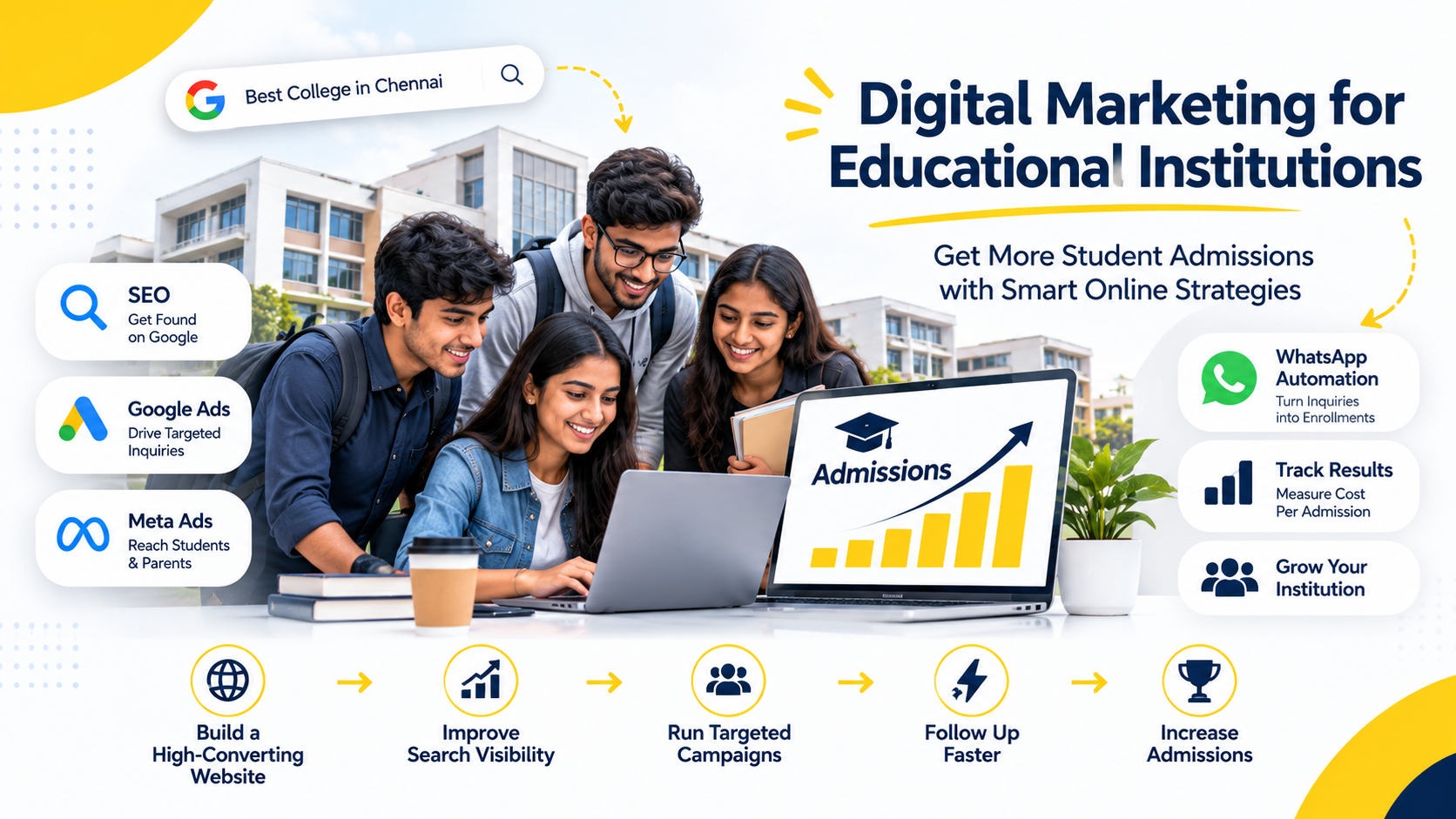
A few years ago, a college could run newspaper ads, put up hoardings, and wait for the phones to ring. That doesn't work anymore.
Today, a student searches on Google at 11 pm. A parent asks ChatGPT which MBA colleges are worth the fees. Someone else watches a campus reel, then opens WhatsApp to ask about hostel facilities. By the time your admissions team hears about them, they've already built a shortlist.
If your institution isn't visible at those moments, you're not in the race.
This guide walks through how to build an online admissions system that works, from your website to the final enrollment. No theory for the sake of it. Just what to fix, in what order.
The Real Shift: From Branding to Admissions Performance
Most institutions treat digital marketing as brand building: a nice logo, a few social posts, an occasional ad. Brand matters, but brand alone doesn't fill seats.
A performance-driven approach asks different questions:
-
How many qualified inquiries did we get this month?
-
How fast did we respond?
-
How many of them visited the campus?
-
How many actually enrolled, and what did each enrollment cost?
Once you start tracking admissions as a pipeline instead of a vague "awareness" goal, every decision gets clearer. Let's build that pipeline in five phases.
Phase 1: Build a Website That Converts Visitors Into Inquiries
Your website is your admissions counselor that never sleeps. If it's slow, confusing, or hard to use on a phone, you lose students before you ever speak to them.
Make it mobile-first
Most prospective students browse on their phones. Open your site on a mid-range Android phone over a normal mobile connection. If pages take more than a few seconds to load, or buttons are hard to tap, fix that first.
Give every program its own landing page
Don't send all your traffic to the home page. A student searching for "BBA admissions" wants to see BBA details, not a general college overview.
Each program page should include:
-
Course overview and duration
-
Eligibility and admission process
-
Fee structure (be upfront, hiding fees kills trust)
-
Placement or career outcomes
-
Faculty highlights
-
One clear call to action: "Apply Now" or "Download Prospectus"
Keep forms short
Every extra field reduces submissions. For a first inquiry, you need name, phone number, program of interest, and maybe city. You can collect the rest during the conversation.
Put the CTA where people can see it
Don't make visitors hunt. A sticky "Apply Now" button on mobile, a prospectus download on every program page, and a WhatsApp chat button usually beat a long "Contact Us" page.
Phase 2: Get Found When Students Are Searching
Once your website works, you need people to reach it. This is where search comes in, and in 2026, "search" means more than Google alone.
Local SEO and Google Business Profile
For most institutions, admissions are local or regional. A student looking for "engineering colleges near me" or "best MBA colleges in Chennai" is giving you a strong signal.
To show up in those results:
-
Claim and fully complete your Google Business Profile
-
Use accurate name, address, phone, and website details everywhere
-
Add real photos of the campus, labs, library, and hostel
-
Choose the right categories and list your main courses
-
Ask students and alumni for reviews, and reply to every one, including the critical ones
Reviews matter more than most institutions realize. A parent comparing three colleges will often read the reviews before they read your website.
Program-focused SEO
Think in clusters, not single pages. For each major program, build a page that targets the main keyword, then support it with articles that answer related questions.
For example, around an MBA program:
-
Main page: "MBA Program in [Chennai ]"
-
Support: eligibility and entrance exam guide
-
Support: MBA specializations explained
-
Support: average MBA fees and ways to fund them
-
Support: career paths after MBA
Each support piece answers a real question and links back to the program page. Over time, this tells Google you're a serious source on the topic.
Match content to intent. Someone searching "how to choose an MBA specialization" is early in the journey and wants guidance. Someone searching "MBA admissions open 2026" is ready to act and wants a clear next step. Don't serve both the same page.
Technical basics
Don't skip these:
-
Fast page speed and clean mobile layout
-
Proper heading structure
-
Schema markup for courses, organization, FAQs, and reviews
-
A clean sitemap and no broken pages
Optimize for AI search (GEO and AEO)
This is the part most institutions are ignoring, and it's a real opportunity.
Prospective students and parents now ask tools like ChatGPT, Perplexity, and Gemini questions such as "Which colleges offer a good B.Com program in Chennai?" These tools pull from sources they can understand and trust. You can improve your chances by making your content easy to read for machines and humans alike.
Practical steps:
-
Write direct answers. Put a short, clear answer near the top of key pages. Then add detail below.
-
Add FAQ sections with schema. Questions like "What is the eligibility for BBA?" or "What is the fee for the MBA program?" should have short, accurate answers.
-
Structure your program data. Duration, fees, eligibility, accreditation, and intake dates should be clearly listed, not buried in a PDF.
-
Be consistent across the web. Your institution's name, details, and claims should match on your website, Google profile, education portals, and social pages. Mixed signals confuse both search engines and AI tools.
-
Build real authority. Get mentioned in credible education directories, news coverage, and alumni pages.
No one can guarantee how AI tools pick sources. But clear, structured, trustworthy content gives you the best shot.
Phase 3: Run Two Campaigns, Not One
Here's where many institutions go wrong. They treat every lead as the same person. In reality, two people are usually involved in the decision: the student and the parent. They care about very different things.
Speaking to students
Students, especially Gen Z and Gen Alpha, want to see what life actually looks like. They trust other students more than they trust brochures.
What works:
-
Instagram Reels and short videos showing real campus life, clubs, events, and classrooms
-
Student-created content, such as day-in-the-life videos and hostel tours
-
Virtual campus tours and 360-degree walkthroughs for students who can't visit
-
WhatsApp chats for quick questions, because many students would rather text than call
Keep it real. Over-polished videos with stock music and perfect smiles feel like ads, and students scroll past them. A slightly rough video from an actual student often performs better.
Speaking to parents
Parents are thinking about different things: Is it safe? Is it worth the money? Will my child get a job?
What works:
-
Clear placement data, with names of recruiters and real salary ranges where you can share them
-
Safety and infrastructure details: hostel rules, transport, campus security, medical support
-
Fee transparency and information on scholarships or education loans
-
Facebook Ads and email, since many parents are active on these
-
LinkedIn content from faculty and leadership to build credibility
-
Alumni stories, especially from people who now work in recognizable companies
A simple rule: students need to feel excited, and parents need to feel confident. Your marketing has to do both.
Paid advertising that supports both
Paid ads can speed things up, but only when the basics are in place.
-
Google Search Ads catch high-intent searches like "BBA admission 2026 in [Chennai]". Send these clicks to the specific program page, not the home page.
-
Meta Ads (Facebook and Instagram) let you target by age, location, and interests. Use them for awareness, lead forms, and campus-event promotion.
-
Retargeting brings back people who visited your site but didn't inquire. Admissions decisions take weeks, so staying visible matters.
Track which campaigns bring real, qualified leads, not just cheap clicks.
Phase 4: Respond Fast and Nurture Every Lead
You can run the best campaigns in the city and still lose admissions if your follow-up is slow.
Think about how it feels from the student's side. They fill in a form and then wait. A few hours later, maybe a day later, someone calls. By then, they've already spoken to two other colleges.
Set a 15-minute rule
Aim to make first contact within 15 minutes of an inquiry. Faster is better.
To make this realistic, you need some automation:
-
Capture the lead from the website, Meta Lead Ads, or Google Ads into a central CRM (HubSpot, LeadSquared, Zoho, or Salesforce, depending on your size and budget).
-
Auto-assign the lead to a counselor based on program, city, or availability.
-
Trigger an instant WhatsApp message that confirms the inquiry and shares the brochure or key details.
-
Alert the counselor to call right away.
-
Escalate if the lead isn't contacted within the time limit.
Nurture beyond the first call
Most students won't decide after one conversation. Keep in touch without being annoying:
-
A short email series covering fees, scholarships, placements, and campus life
-
WhatsApp reminders for application deadlines and open days
-
Invitations to virtual or on-campus visits
-
Personal follow-up from counselors for serious prospects
Chatbots can help answer basic questions at night, but don't hide behind them. When a student wants to talk to a human, make that easy.
Keep your counselors in the loop
Automation doesn't replace your admissions team. It frees them to spend time on conversations that matter. Train counselors to listen first, answer honestly, and follow up consistently.
Phase 5: Measure What Actually Matters
Here's the uncomfortable truth: many institutions celebrate lead numbers while admissions stay flat. More leads don't always mean more students.
Look beyond cost per lead
Cost per lead (CPL) is easy to track, but it can mislead you. A campaign that brings 500 cheap, unqualified leads can look better on paper than one that brings 80 serious ones.
The number that tells the real story is cost per admission (CPA), meaning the cost of each enrolled student:
CPA = (Total digital ad spend + agency and tools costs) ÷ Total students enrolled
For example, if you spend ₹10,00,000 across ads, tools, and agency fees and enroll 50 students from those efforts, your CPA is ₹20,000 per student. Compare that figure to the fee revenue and lifetime value of a student, and you can see whether your marketing is actually profitable.
Build a simple admissions dashboard
Track these in one place:
-
Website visits by source
-
Inquiries by channel and program
-
Response time (average time to first contact)
-
Leads to campus visit rate
-
Visit to application rate
-
Application to enrollment rate
-
CPL and CPA by campaign
When you can see each stage, you can fix the leak. If many leads come in but few visits happen, the problem may be follow-up. If visits are high but applications are low, maybe fees or scholarships need clearer communication.
Review monthly, adjust quickly
Admissions seasons are short. Check performance every week during peak periods. Pause what isn't working and put the budget behind what is.
Build Trust Before You Ask for the Application
Education is a high-stakes decision. Families are spending significant money and trusting you with years of a young person's life. That means trust is the real conversion tool.
A few ways to build it:
-
Publish verifiable outcomes. Placement numbers, pass rates, and recruiter names should be real and easy to check.
-
Share authentic reviews and alumni stories. Include their names, photos, and where they work now, with permission.
-
Respond to criticism publicly and calmly. How you handle a bad review says more than ten good ones.
-
Be clear about fees and policies. Surprises after admission destroy reputations quickly.
-
Show your people. Faculty profiles, leadership messages, and student voices make the institution feel real.
Don't exaggerate. If your placement record is average but your teaching quality and mentoring are excellent, say that. Honest marketing lasts longer than inflated claims.
A Simple 90-Day Starting Plan
If this feels like a lot, start small.
Days 1 to 30: Fix the foundation
-
Audit the website for mobile speed and clarity
-
Build or improve landing pages for your top three programs
-
Complete your Google Business Profile
-
Set up a basic CRM and WhatsApp response flow
Days 31 to 60: Get visible
-
Publish content around your main programs
-
Add FAQ sections with schema
-
Launch Google Search Ads for top programs
-
Start a regular student-led social content series
Days 61 to 90: Optimize and scale
-
Add Meta Ads and retargeting
-
Launch parent-focused content and email follow-ups
-
Build your admissions dashboard
-
Review CPL and CPA, then shift budget to the best channels
Common Mistakes to Avoid
-
Sending all ad traffic to the home page
-
Ignoring reviews and Google Business Profile
-
Treating students and parents as one audience
-
Slow or inconsistent lead follow-up
-
Measuring only clicks and leads, not enrollments
-
Copying competitors instead of showing what makes you different
-
Publishing polished content that doesn't feel real
Why Choose Tecminion for Educational Institution Digital Marketing?
Choosing the right digital marketing partner can help educational institutions build a more structured approach to online visibility and student admission lead generation.
At Tecminion, we understand that every industry has different marketing requirements. Educational institutions need strategies that connect with students and parents while communicating the value of their courses and programmes.
Our digitahttps://tecminion.com/l marketing services can support educational institutions through:
Search Engine Optimization: Improve organic search visibility and help prospective students discover relevant courses and educational programmes.
Google Ads Management: Create search campaigns that target relevant admission-related searches and generate enquiries.
Meta Ads Management: Reach students and parents through targeted Facebook and Instagram advertising campaigns.
Website and Landing Page Development: Build user-friendly pages that present course information and encourage admission enquiries.
Lead Generation: Develop campaigns and enquiry processes designed to attract relevant prospective students.
Marketing Automation: Support enquiry acknowledgement, lead organization and follow-up workflows.
Our approach focuses on understanding the institution, its audience and its admission objectives before recommending suitable digital marketing activities.
Whether you manage a school, college, university or coaching centre, a well-planned digital marketing strategy can help strengthen your online presence and create more opportunities to connect with prospective students.
Final Thoughts
Generating more admissions online isn't about doing everything. It's about doing the right things in the right order: a website that converts, content that gets found, messages that speak to both students and parents, fast follow-up, and numbers that tell the truth.
Start with the leaks in your current process. Fix those, then build on what works. Institutions that connect each step, from the first search to the final enrollment, will keep winning admissions while others keep guessing.
If you'd like help building an admissions-focused digital strategy for your institution, get in touch with our team. We can start by looking at where you're losing students today.
FAQ
1. What is digital marketing for educational institutions?
It means using online channels such as SEO, Google Ads, Meta Ads, social media, email and WhatsApp to attract prospective students and parents, and turn their inquiries into admissions.
2. Which digital marketing channel works best for student admissions?
There’s no single best channel. Google Search Ads and local SEO catch students who are actively searching. Meta Ads and social content build awareness and reach parents. The best results come when these work together with fast follow-up.
3. How can a college get more admissions through Google?
Complete your Google Business Profile, build a dedicated landing page for each program, collect genuine reviews, and run Google Search Ads for admission-related searches. Send each ad click to the matching program page, not the home page.
4. What is cost per admission (CPA), and why does it matter?
CPA is your total digital spend (ads, tools and agency costs) divided by the number of students actually enrolled. It matters more than cost per lead because it shows whether your marketing brings in real admissions.
5. How fast should we respond to an admission inquiry?
Aim for first contact within 15 minutes. An instant WhatsApp confirmation plus a counselor call makes this realistic. Slow follow-up is one of the most common reasons institutions lose students to competitors.
6. How can educational institutions show up in AI search results like ChatGPT or Perplexity?
Put clear, direct answers near the top of key pages, add FAQ schema, and list program details (fees, eligibility, duration, accreditation) in a structured way. Keep your institution’s details consistent across your website, Google profile and education portals. No one can guarantee AI visibility, but structured and trustworthy content improves your chances.
7. How long does it take to see results from digital marketing for admissions?
Paid ads can bring inquiries within days. SEO usually takes a few months to build momentum. Planning campaigns well before the admission season gives you the best results.