
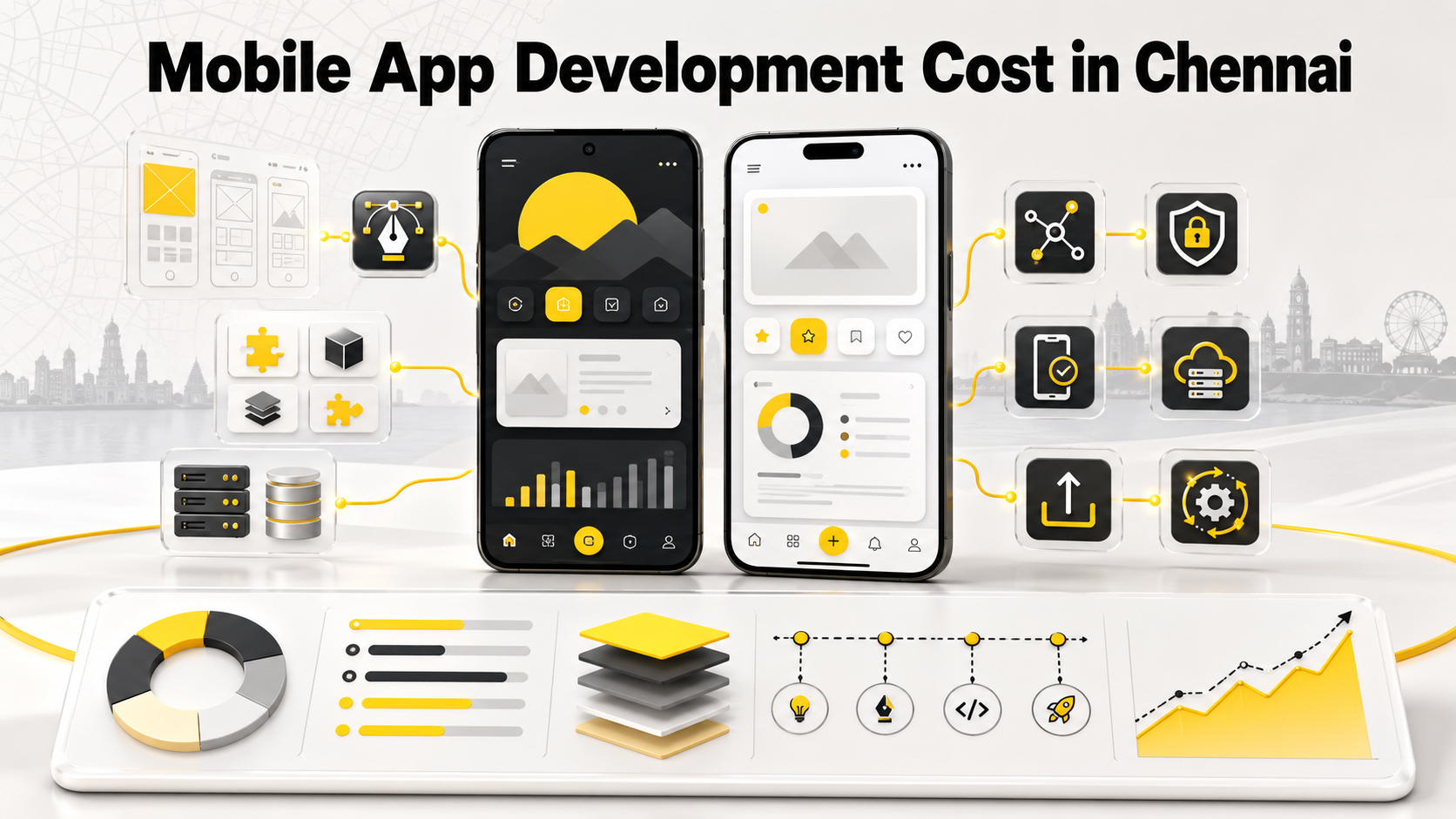
Building a mobile app can help a business improve customer convenience, streamline internal operations, increase repeat engagement and create new revenue opportunities. However, one of the first questions most business owners ask is: “How much does mobile app development cost in Chennai?”
There is no single price that applies to every app. A simple appointment-booking application and a multi-vendor delivery platform may both be called mobile apps, but their development requirements are completely different.
The final cost depends on the platform, number of features, user roles, design complexity, integrations, security requirements, testing effort and long-term maintenance. Understanding these factors before requesting a quotation helps businesses plan a realistic budget and avoid unexpected expenses.
Typical Mobile App Development Cost in Chennai
The following figures can be used as broad planning estimates rather than fixed quotations:
| App category | Approximate planning range | Common use cases |
|---|---|---|
| Basic MVP | ₹2.5 lakh–₹6 lakh |
Business information, enquiry, booking or simple internal application |
| Medium-complexity app | ₹6 lakh–₹18 lakh |
E-commerce, customer accounts, payments, location features and dashboards |
| Advanced application | ₹18 lakh–₹50 lakh or more |
Multi-vendor platforms, logistics, healthcare, fintech or real-time systems |
| Enterprise solution | Scope-based quotation |
Multiple user roles, advanced security, complex integrations and high scalability |
These ranges can change based on the exact requirements, development approach and support expected after launch. A detailed quotation should therefore be prepared only after the business goals, user journey and technical scope have been defined.
1. The App’s Purpose and Business Model
Development cost begins with the purpose of the application.
A simple app that provides business information, accepts enquiries and allows customers to book appointments will require fewer development hours than an application that manages products, payments, delivery partners and real-time order tracking.
Before discussing technology, a business should clearly define:
-
Who will use the app?
-
What problem will it solve?
-
What action should users complete?
-
How will the app support business growth?
-
Does it need to generate revenue directly?
-
Which features are essential for the first version?
Clear requirements reduce unnecessary development and prevent the project from expanding beyond its original budget.
2. Android, iOS or Both Platforms
The selected platform has a major effect on the total cost.
Android development
Android can be suitable when a business wants to reach a broad range of mobile users. However, the application may need to be tested across different screen sizes, device specifications and operating-system versions.
iOS development
An iOS application is developed for Apple devices. The number of device variations is more controlled, but the app must still meet Apple’s technical and review requirements.
Apple currently charges an annual membership fee for its Developer Program, while Google Play uses a one-time developer-registration fee. These platform expenses should be included separately in the project budget.
Cross-platform development
Frameworks such as Flutter allow developers to maintain a shared codebase for Android and iOS. This can reduce duplicated development effort when both platforms require similar functionality.
Cross-platform development is not automatically the right option for every project. Apps that rely heavily on device-specific capabilities, advanced background processing or platform-exclusive features may still require additional native development.
The right platform should be selected based on the target audience and functional requirements—not only the lowest initial quote.
3. Number and Complexity of Features
Each additional feature requires design, development, testing and maintenance.
Common mobile-app features include:
-
User registration and login
-
Social or OTP authentication
-
Product or service listings
-
Search and filtering
-
Appointment booking
-
Shopping cart and checkout
-
Online payment integration
-
Push notifications
-
Location and map integration
-
Image or document uploads
-
Real-time chat
-
Order tracking
-
Ratings and reviews
-
Subscription management
-
Admin dashboard
-
Analytics and reports
A basic login form may be straightforward. However, login with OTP verification, multiple account types, role-based access and advanced security requires significantly more work.
Businesses can control the initial investment by separating features into three groups:
-
Essential for launch
-
Useful after customer validation
-
Optional future improvements
This process creates a focused minimum viable product instead of an expensive first version filled with untested features.
4. UI and UX Design
A functional app is not automatically an easy-to-use app.
UI design determines the visual appearance of screens, buttons, menus, forms and navigation. UX design focuses on how easily users can understand and complete important tasks.
The design process may include:
-
User-flow planning
-
Wireframes
-
Interactive prototypes
-
Visual design system
-
Mobile accessibility
-
Device-responsive layouts
-
Usability testing
-
Design revisions
Using a basic template may reduce the initial design cost, but it can limit brand differentiation and usability. A completely custom interface requires more time but can provide a more consistent customer experience.
The correct level of design depends on how customers will use the application and how important the app is to the overall brand.
5. Backend Development and Admin Dashboard
Many mobile apps require a backend system to store and manage data.
For example, a service-booking application may need to manage customers, appointments, staff availability, payments and notifications. An e-commerce application may require inventory, orders, delivery details, discount codes and customer-support functions.
Backend costs depend on:
-
Database structure
-
Number of user roles
-
Admin permissions
-
Server requirements
-
Data-processing volume
-
Reporting features
-
Integration with existing systems
-
Expected number of users
A well-planned admin dashboard helps the business manage app activity without relying on the development team for every small change.
6. Third-Party Integrations
Connecting an application to external services can improve functionality, but every integration adds development and testing work.
Common integrations include:
-
Payment gateways
-
Google Maps or location services
-
SMS and OTP providers
-
Email services
-
WhatsApp communication
-
Customer relationship management systems
-
Accounting software
-
Delivery platforms
-
Analytics tools
-
Cloud storage
-
Existing website databases
Some services also charge usage-based or subscription fees. These recurring expenses are separate from the initial development cost and should be identified before the project begins.
7. Security and Data Protection
Security should be planned from the beginning, particularly when an application handles personal information, payments, health records or confidential business data.
Security-related work may include:
-
Secure authentication
-
Password and token protection
-
Data encryption
-
Role-based access
-
Secure API development
-
Payment-security requirements
-
Activity logging
-
Backup and recovery
-
Vulnerability testing
-
Privacy controls
A basic business-information app may require standard security measures. A fintech, healthcare or enterprise application will need a more extensive security architecture and testing process.
Reducing the budget by removing essential security work can create much higher costs after launch.
8. Testing and Quality Assurance
Testing ensures that the app works correctly across supported devices and real-world conditions.
Quality assurance may cover:
-
Functional testing
-
User-interface testing
-
Device compatibility
-
Performance and loading speed
-
Network interruption handling
-
Payment testing
-
Security testing
-
Notification testing
-
User acceptance testing
-
Regression testing after fixes
Testing should not be treated as an optional final step. An app that crashes, processes a payment incorrectly or loses user data can quickly damage customer trust.
The more features, devices and integrations involved, the greater the testing requirement.
9. App Store Launch Expenses
Development does not end when the code is complete.
The application must be prepared for Google Play, the Apple App Store or both. This may require:
-
Developer-account setup
-
App name and category selection
-
Screenshots and store graphics
-
Privacy-policy details
-
App description
-
Permission declarations
-
Test releases
-
Review-response changes
-
Production deployment
Google currently charges a US$25 one-time Play Console registration fee. Apple’s Developer Program currently costs US$99 per membership year, with regional pricing shown during enrolment.
These fees are small compared with development costs, but businesses should still assign ownership of the developer accounts and store listings before launch.
10. Maintenance After Launch
A mobile app is an ongoing digital product rather than a one-time file.
After launch, the app may require:
-
Bug fixes
-
Operating-system compatibility updates
-
Security patches
-
Performance monitoring
-
Server maintenance
-
Feature improvements
-
Integration updates
-
Store-policy compliance
-
Analytics review
-
Customer-feedback improvements
Businesses should ask whether the development quotation includes a warranty period, technical support and future maintenance.
A low initial quote may become expensive later if the source code is poorly structured or support is unavailable.
How Can a Business Control App Development Cost?
Controlling cost does not mean selecting the cheapest developer. It means reducing uncertainty and avoiding unnecessary work.
Begin with one measurable goal
The first version should solve one clear business problem, such as improving appointment bookings, simplifying field operations or allowing customers to place repeat orders.
Validate the user journey first
Create wireframes or a clickable prototype before beginning full development. It is cheaper to correct a screen flow during the design stage than after coding.
Launch an MVP
An MVP contains only the features required to test the idea with real users. Additional features can be developed after customer behaviour provides useful evidence.
Use existing systems when appropriate
A secure and reliable third-party service may be more practical than developing every feature from the beginning.
Keep scope decisions documented
The quotation should clearly specify the included screens, platforms, integrations, user roles, testing and support. New requirements should be evaluated separately instead of being added informally.
Plan maintenance before launch
Discuss ownership, hosting, source-code access, updates and post-launch support before approving the project.
How to Compare Mobile App Development Quotations
Two quotations may show very different prices because they include different levels of work.
Before choosing a development partner, check whether the quotation covers:
-
Requirement analysis
-
UI and UX design
-
Android, iOS or both
-
Backend and admin dashboard
-
API integrations
-
Testing
-
Store deployment
-
Source-code ownership
-
Hosting and third-party charges
-
Warranty or maintenance
-
Project timeline
-
Change-request process
A professional quotation should explain what will be delivered—not only show one total amount.
Businesses planning a new application can discuss their goals with Tecminion’s mobile app development services in Chennai to define the right platform, essential features and realistic project scope before development begins.
Frequently Asked Questions
How much does a basic mobile app cost in Chennai?
A basic MVP may require an approximate planning budget of ₹2.5 lakh to ₹6 lakh. The final cost depends on the number of screens, backend requirements, platform, design and integrations.
Is Android app development cheaper than iOS?
Not always. Cost depends more on functionality and technical scope than on the platform name. If both Android and iOS are required, a suitable cross-platform approach may reduce duplicated work.
Can I build an app for less than ₹1 lakh?
A very limited prototype, template-based application or no-code implementation may be possible within a smaller budget. However, custom development, backend infrastructure, proper testing and post-launch support generally require a larger investment.
How long does mobile app development take?
A focused MVP may take a few months, while a complex application with several user roles and integrations can take considerably longer. The timeline should be estimated after the requirements and user flows are documented.
Does the development quotation include Play Store and App Store fees?
Not necessarily. Developer-account charges, hosting, SMS, maps, payment gateways and other third-party services may be billed separately. These costs should be clearly listed in the quotation.
Who should own the app developer accounts and source code?
The business should ideally own its developer accounts, production credentials and final source code, subject to the agreed contract. This makes future maintenance and vendor changes easier.
Final Thoughts
Mobile app development cost in Chennai depends on much more than the number of screens. Platform selection, user experience, backend systems, integrations, security, testing and maintenance all influence the investment.
A business can control cost by defining one clear goal, launching with essential features and documenting the project scope before development begins.
The cheapest quotation is not always the most economical long-term choice. A secure, maintainable application that solves a real customer or operational problem can deliver far greater value than an inexpensive app that requires frequent rebuilding.