
Why Is My Website Indexed but Not Ranking on Google?
Publishing a website and seeing its pages appear in Google’s index feels like an important milestone. But many business owners face a confusing situation soon afterwards: Google Search Console says the page is indexed, yet the website cannot be found for its target keywords.
This is especially common with newly launched websites.
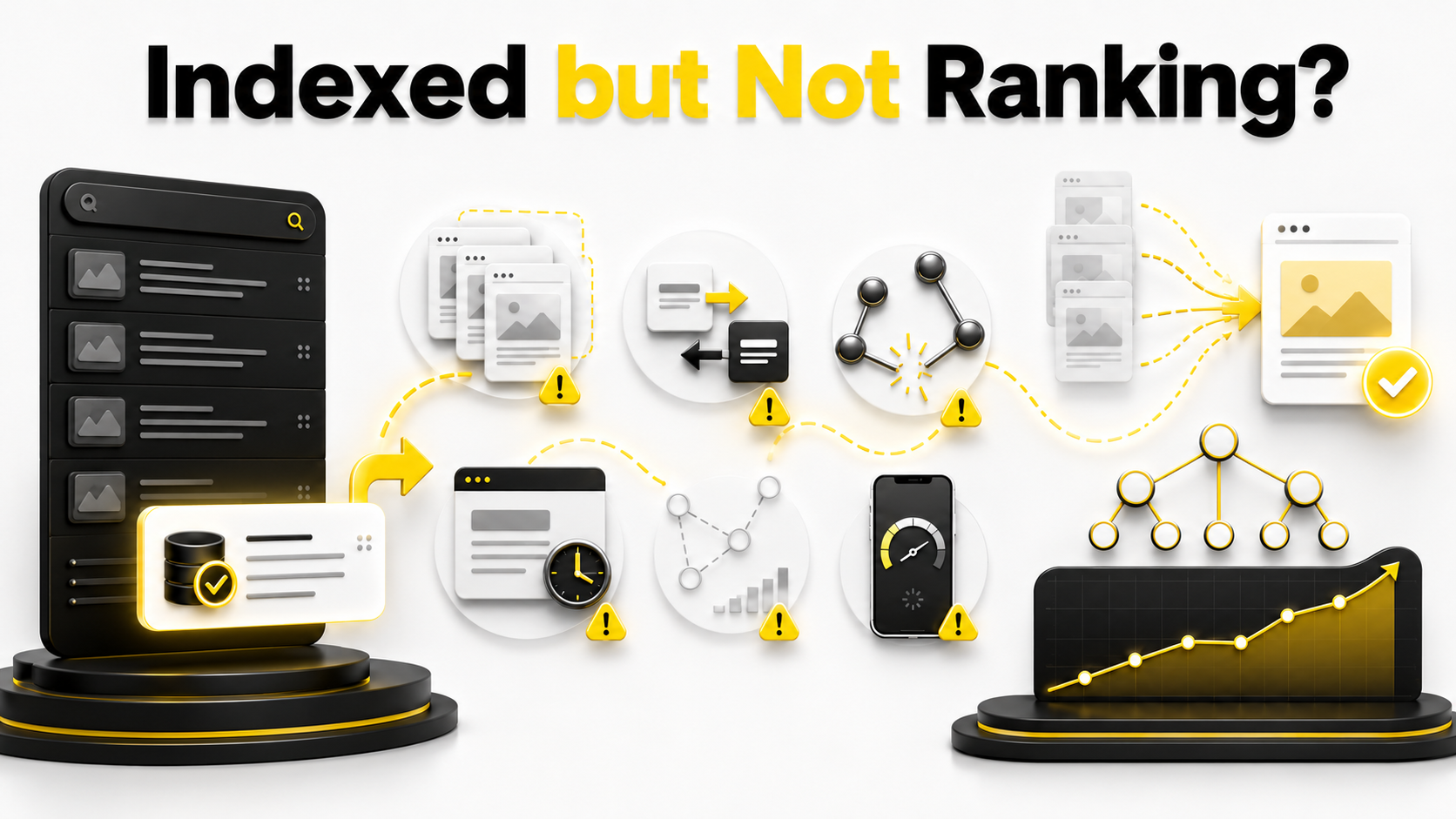
Indexing and ranking are two different stages of search visibility. An indexed page is eligible to appear in Google Search. It does not mean Google has decided that the page is one of the most relevant, useful or trustworthy results for a competitive query.
A page can remain indexed while ranking beyond the first several pages, appearing only for a small number of searches or receiving impressions for unexpected keywords.
Understanding why this happens is the first step towards fixing it.
What Does “Indexed” Actually Mean?
Google generally discovers a page through links, sitemaps or previous crawl information. It then crawls the page and attempts to understand its text, images, headings, title, links and overall purpose.
When Google includes the page in its searchable database, the page is considered indexed.
According to Google’s explanation of how Search works, indexing includes analysing the page and determining whether it is a duplicate or the canonical version of a group of similar pages.
Indexing therefore means:
-
Google can access the page
-
Google has processed its content
-
The page may be eligible to appear in search results
It does not mean:
-
The page will rank on Page 1
-
Every target keyword will trigger the page
-
The page is considered more authoritative than competitors
-
Traffic or enquiries are guaranteed
Ranking happens after indexing. Google’s systems compare the indexed page with other eligible results to decide which pages appear for a particular search.
1. The Website Is Still New
A recently launched website has very little historical information.
Google may not yet have enough signals to understand:
-
Which pages are most important
-
What topics the website genuinely specializes in
-
Whether the business information is consistent
-
How users interact with the website
-
Which external sources mention or reference the brand
-
How often the website publishes and maintains useful information
New pages can receive early impressions and ranking fluctuations while Google continues crawling and evaluating the site.
This does not mean a new domain must remain invisible for a fixed period. Some pages may rank quickly for specific or low-competition searches, while competitive commercial keywords can require significantly more time and authority.
Instead of checking rankings every few hours, monitor Search Console weekly and look for gradual changes in impressions, relevant queries and landing-page visibility.
For a realistic explanation of early ranking movement, read our guide on how long SEO takes to show results in Chennai.
2. The Page Does Not Match the Search Intent
Search intent is the purpose behind a query.
Someone searching for “SEO services in Chennai” is likely comparing agencies or looking for professional assistance. That is commercial intent.
Someone searching for “how long does SEO take” wants information before making a decision. That is informational intent.
If a blog article attempts to rank for a strongly commercial service query, Google may prefer established service pages from competing websites. Similarly, a sales-focused landing page may struggle to rank for a query that deserves an educational guide.
Review the current top results for the target query and identify:
-
Whether Google shows service pages, guides, lists or product pages
-
How detailed those pages are
-
What questions they answer
-
Whether the results have a local or national focus
-
What type of action they expect visitors to take
Do not copy the competing pages. Use the results to understand what users likely expect from that search.
3. Multiple Pages Are Competing for the Same Keyword
Keyword cannibalization happens when several pages on the same website target nearly the same search intent.
For example, a website may have:
-
/seo-company-chennai -
/seo-services-chennai -
/best-seo-agency-chennai
If each page describes the same service, Google may struggle to identify which one should rank.
Signs of internal competition include:
-
Different URLs appearing for the same query on different days
-
An old page ranking instead of the new preferred page
-
Rankings repeatedly rising and falling
-
Impressions divided between similar landing pages
-
Google selecting a different canonical page
The solution is not always to delete content. First decide whether the pages serve genuinely different needs.
If they have the same purpose:
-
Select the strongest preferred URL.
-
Combine any useful unique information.
-
Redirect replaced URLs permanently to the preferred page.
-
Update internal links to point directly to the final destination.
-
Keep only the canonical URL in the sitemap.
One clear, comprehensive page is often stronger than several pages competing for the same intent.
4. Old URLs Are Still Accessible
A website redesign frequently changes page slugs and structure. The new pages may be indexed correctly, but the old versions may continue returning a 200 OK response.
Removing old URLs from the sitemap is not enough. Google may still discover them through historical crawl information, old internal links or external references.
When an old page has a direct replacement, use a one-step permanent redirect.
For example:
Old SEO page → 301 redirect → Current SEO service page
Avoid redirect chains such as:
Old page → Temporary page → Category page → Final service page
After implementing the redirect:
-
Test the old URL in an Incognito browser
-
Confirm it reaches the correct new page
-
Make sure the final page returns
200 OK -
Update internal links to the new URL
-
Do not repeatedly request indexing for the redirected page
Redirect consolidation may take time to be fully reflected in Google’s index and performance reports.
5. The Content Is Too Similar to Existing Results
A page can be technically correct and still offer very little reason to rank above established competitors.
Generic content often repeats statements such as:
-
We provide the best service
-
We use advanced strategies
-
We deliver high-quality results
-
Contact us for affordable solutions
These claims do not help users evaluate the service or understand the company’s actual approach.
Useful content should provide details that competitors have not explained clearly, such as:
-
The exact process followed
-
Who the service is suitable for
-
Common problems identified during audits
-
Realistic timelines
-
Pricing factors
-
Limitations and risks
-
Examples based on genuine experience
-
Measurable outcomes that can be supported with evidence
Google recommends creating helpful, reliable, people-first content rather than publishing primarily to manipulate rankings.
Before expanding the word count, ask whether the additional content makes the page more useful.
6. Internal Links Are Not Strengthening the Page
Internal links help users discover related content and help search engines understand the relationship between pages.
A website may publish several SEO articles without linking any of them to the main SEO service page. In that case, the informational content does little to clarify which page represents the core commercial service.
A stronger content structure might look like this:
SEO timeline article
          ↓
Main SEO service page
          ↑
Local SEO guide
Internal links should:
-
Appear within relevant content
-
Use descriptive, natural anchor text
-
Point directly to the canonical URL
-
Help the visitor continue their research
-
Avoid repeating the same exact-match anchor everywhere
Google’s link best practices explain that links help Google discover pages and understand their relevance.
For businesses that need help connecting technical fixes, keyword intent and content structure, Tecminion provides SEO services in Chennai focused on building sustainable organic visibility.
7. The Website Has Limited External Authority
For competitive searches, good on-page content may not be enough on its own.
Google also evaluates signals beyond the page. A new website may be competing against businesses that have:
-
Been active online for many years
-
Earned relevant editorial links
-
Received genuine customer reviews
-
Built strong brand recognition
-
Published original research or case studies
-
Been mentioned by local or industry organizations
This does not mean a business should buy hundreds of backlinks.
Low-quality directory links, automated submissions, unrelated guest posts and repeated exact-match anchors can create an unnatural link profile without generating meaningful business value.
Safer authority-building methods include:
-
Publishing original educational content
-
Creating useful infographics and presentations
-
Sharing genuine case studies
-
Contributing thoughtful articles on relevant platforms
-
Participating in industry discussions
-
Earning client reviews and legitimate business mentions
-
Distributing original visual resources with clear source attribution
Authority usually develops gradually through relevance, usefulness and genuine recognition.
8. The Page Has Weak Trust Signals
A service page makes claims about a business. Visitors and search engines need reasons to trust those claims.
Useful trust elements include:
-
Accurate business name, address and phone number
-
Genuine team or company information
-
Real client reviews with approval
-
Case studies supported by actual data
-
Clear service processes
-
Contact information
-
Privacy and policy pages
-
Author information for educational content
-
Transparent explanations without unrealistic guarantees
Avoid publishing invented testimonials, fake review schema or performance numbers that cannot be verified.
If a page claims that a campaign generated a particular number of leads or ranking improvements, the business should be able to support that statement with reports or project evidence.
9. Mobile Experience or Page Functionality Is Poor
Google primarily uses the mobile version of a website for indexing and ranking.
A page that looks correct on desktop may have problems on mobile:
-
Text hidden behind design elements
-
Buttons placed too close together
-
Slow-loading hero images
-
Content missing from the mobile version
-
Pop-ups blocking the main content
-
Navigation that cannot be used
-
Contact forms that fail during submission
Test important pages on real mobile devices as well as browser emulators.
The contact journey is particularly important. A ranking has limited business value when the visitor cannot submit the form, call the company or open WhatsApp.
10. The Website Has Local Relevance Gaps
A Chennai business targeting local customers needs more than the word “Chennai” repeated across the page.
Local relevance may be supported by:
-
A complete Google Business Profile
-
Consistent business name, address and phone information
-
Genuine customer reviews
-
Accurate service areas
-
Local project evidence
-
Relevant Chennai content
-
LocalBusiness structured data that matches visible information
-
Trusted local mentions
Creating dozens of nearly identical area pages for Velachery, Anna Nagar, Tambaram and Porur is not a substitute for genuine local relevance.
Businesses dependent on nearby customers can learn more from our guide on how Local SEO helps Chennai businesses appear on Google Maps.
11. The Target Keyword Is Highly Competitive
A page may be relevant and useful but still compete against stronger websites.
Commercial searches such as “digital marketing agency in Chennai” or “SEO company in Chennai” can include established agencies with extensive content, reviews, backlinks, case studies and years of search history.
Instead of judging progress only by the main keyword, monitor:
-
Closely related queries
-
Location-specific variations
-
Impressions for commercial terms
-
Supporting informational keywords
-
Movement from positions 50–100 towards the top 30
-
Organic visits and enquiries
-
Which landing pages Google is selecting
Early progress often appears in these supporting signals before the main keyword reaches the first page.
12. Search Console Position Is Being Misunderstood
Search Console reports an average position, not a fixed universal rank.
The displayed position can include searches from different:
-
Locations
-
Devices
-
Dates
-
Search-result layouts
-
Query variations
A report showing an average position of 15 does not mean the website will always appear exactly at position 15 during a manual search.
Personalized results, location and repeated searches can also make manual checking unreliable.
Use Search Console to identify trends over meaningful periods instead of treating one search or one day as the final result.
A Practical Indexed-but-Not-Ranking Checklist
When an indexed page is not ranking, check the following:
Search intent
-
Does the page format match what searchers expect?
-
Is the keyword commercial, informational, local or transactional?
Page targeting
-
Does one preferred page own the keyword group?
-
Are similar pages competing for the same intent?
Technical signals
-
Does the page return
200 OK? -
Is it self-canonical?
-
Is it included in the sitemap?
-
Is it mobile-friendly?
-
Can Google access its important content?
Old URLs
-
Do previous versions still return
200 OK? -
Are permanent redirects working in one step?
-
Do internal links point directly to the new page?
Content quality
-
Does the page answer real customer questions?
-
Does it provide original experience or evidence?
-
Are claims factual and supportable?
Internal links
-
Do relevant articles link to the preferred page?
-
Are anchors descriptive and natural?
-
Are there broken or redirected internal links?
Authority and trust
-
Has the business earned relevant mentions?
-
Are reviews and testimonials genuine?
-
Are the contact and business details consistent?
Measurement
-
Are impressions increasing?
-
Is Google selecting the intended landing page?
-
Are positions improving over several weeks?
-
Are organic visits producing useful actions?
Final Thoughts
An indexed page is not necessarily a competitive page.
Indexing confirms that Google can include the URL in its search system. Ranking depends on whether the page satisfies the query better than other eligible results and whether the broader website provides clear technical, content and trust signals.
When a page is indexed but not ranking, publishing more content should not be the automatic response.
First confirm that the correct page owns the search intent. Consolidate duplicate URLs, repair internal links, improve the usefulness of the content, strengthen trust and monitor performance over time.
Once that foundation is clear, new content can support the page instead of competing with it.