
Walk through any industrial area in Tamil Nadu and you will see the same thing. Good machines, skilled people, full order books. Ask how the next customer will find them, and the answer is usually a name. A dealer, a friend, an old buyer.
That works, until it doesn't. A dealer moves to a competitor. A big customer cuts orders. Suddenly the whole business depends on three phone numbers.
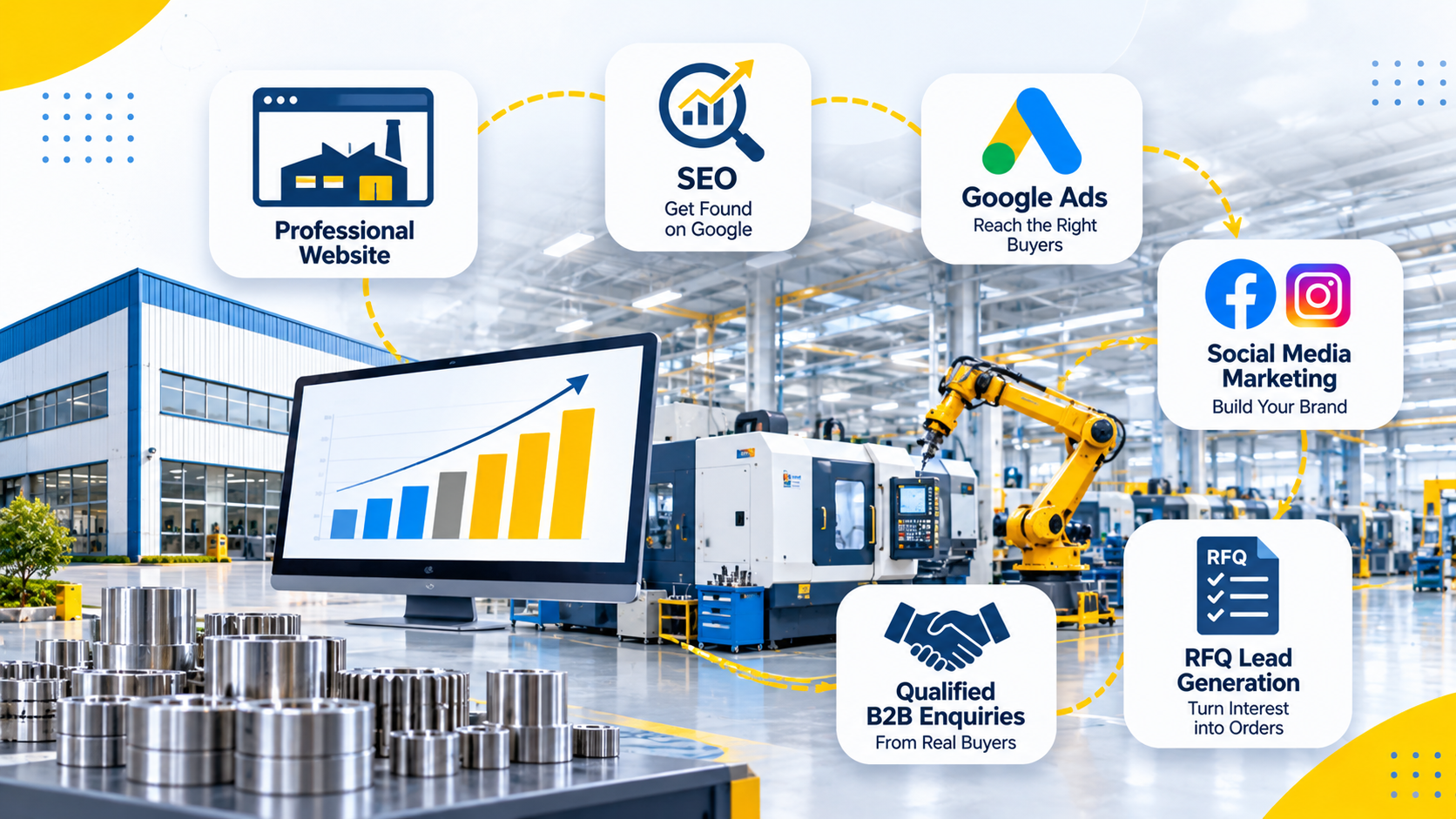
This post explains how we built digital marketing for manufacturing companies from zero for one of our clients. A proper website, active social media, and Meta ads that bring in quality leads. We will share the steps, the mistakes we avoided, and what we would tell any manufacturer thinking of doing the same.
Why digital marketing for manufacturing companies is different
Marketing a manufacturing business is not like marketing a restaurant or a clinic. Three things change the game.
The buyer is a business, not a person. A purchase manager comparing three suppliers does not click an ad on impulse. They check your website, look at your products, search your company name and sometimes ask for references. Your online presence has to hold up under that checking.
The sales cycle is long. An enquiry today can turn into an order after weeks of quotations, samples and negotiation. So the goal is not likes or clicks. It is a steady stream of genuine requirements reaching your sales team.
Volume is not the point. A consumer brand may be happy with 1,000 leads. A manufacturer needs ten buyers who actually need 5,000 units. That is why lead generation for manufacturing companies is mostly about filtering, not about reach. The same goes for any B2B lead generation effort: fewer, better enquiries beat a long list of names nobody can call.
Where the client started
The client is a manufacturing business that had been running well for years. They made a solid product and had regular buyers. But almost nothing was coming from online. They had no proper website, no active social media presence, and no way to track where enquiries came from. Sales depended mostly on referrals and dealer contacts.
Their goal was simple: get more genuine enquiries from buyers who actually need what they make, without relying only on referrals.
The plan we made before touching anything
Before building anything, we sat down and answered four questions. We do this for every client, but it matters even more in B2B.
-
Who exactly is the buyer? Not "businesses in India". We listed the industries, company sizes and job titles that actually place orders: owners, purchase heads, production managers.
-
What do they search for? We mapped the keywords buyers use, from product names to "manufacturer near me" type searches, so the website and content would match them.
-
What counts as a good lead? We agreed this with the client upfront: right requirement, right quantity, right location. Everything else is noise.
-
How will we know it is working? Tracking on the website, a clean enquiry form, and a simple sheet to record every lead and what happened to it.
This step feels slow, because nothing is visible yet. But it stops you from spending money on the wrong things later.
Step 1: A website that works like a salesperson
For manufacturing companies, the website is not a brochure. It is the first thing a buyer checks before sending an RFQ. If it looks outdated or vague, the enquiry goes to the competitor whose site looks serious.
So we built a fast, mobile-friendly website for the manufacturing company around what buyers actually look for:
-
Clear product pages with specifications, uses and real photos
-
Factory, capacity and quality details, including certifications where relevant
-
An enquiry form on every key page, short enough that people fill it
-
WhatsApp click-to-chat, because many Indian buyers prefer a quick message to a form
-
Fast loading on mobile, since owners and purchase managers often browse from their phones
We kept the design simple and the language plain. No big claims, no stock photos of handshakes. If you are planning something similar, our web development services in Chennai cover design, build and the SEO groundwork in one go.
Step 2: SEO for manufacturers, so buyers can find you
A new website gets no visitors on its own. SEO for manufacturing companies is slow, but it keeps paying after the work is done, so we started it from week one.
What we focused on:
-
Product-intent keywords. People searching "[product] manufacturer" or "[product] supplier" are much closer to buying than people searching general terms.
-
One page per product or product group, each with its own title, description and headings, instead of one crowded products page.
-
Content that answers buyer questions, like how to choose between two materials or what affects pricing. Buyers read these before they ever call.
-
Technical basics. Clean URLs, fast pages, proper schema and a Google Business Profile for the company.
Honest note: SEO takes months. That is why we did not rely on it alone. Our SEO services in Chennai page explains how we approach it. In the meantime, social media and Meta ads handled the early traction.
Step 3: Social media that builds trust, not just followers
People often say social media marketing for the manufacturing industry makes no sense. Who buys industrial products from Instagram? Nobody, directly. But buyers do check. A purchase manager who receives a quotation will look you up, and a page that has been silent for two years makes them wonder if the company is still active.
So the aim of social media here was credibility. We handled the setup through social media marketing and the regular posting through social media management.
What worked:
-
Real factory content. Machines running, products being packed, quality checks, deliveries leaving the gate. This builds more trust than any polished template.
-
Short videos. Our video editing team cut simple reels from phone footage. Rough but real beats slick but fake.
-
Product and application posts. What the product is, where it is used, what makes it different.
-
Consistent branding. Our graphic design team made the creatives, so every post looked like it came from the same serious company.
Consistency mattered more than frequency. A page that posts steadily looks alive, and that is all a buyer needs to see.
Step 4: Meta ads for quality leads
This is where most manufacturers lose money. Running Meta ads for manufacturing companies is easy. Getting quality leads from them is the hard part. A basic lead form with a broad audience will give you plenty of names: students, job seekers, curious scrollers. Your sales team then wastes days calling people who will never buy.
Here is what we did differently:
-
Narrow targeting. Business owners, purchase and production roles, and relevant industries, instead of a broad audience.
-
Qualifying questions in the form. What do you need, roughly how much, and where. A few extra seconds for the buyer, a lot of time saved for the sales team.
-
A clear message in the ad. It said what the company makes and who it is for, so the wrong people scrolled past.
-
[Fast follow-up on WhatsApp within minutes.]
-
A weekly lead review. We checked which ads brought good leads, not just cheap ones, and moved the budget accordingly.
We also ran Google Ads alongside Meta, to catch buyers who were already searching for the product.
Step 5: Tracking every lead, not just counting them
Most agencies report how many leads came in. We also tracked what happened to each one. Every enquiry went into a simple sheet with its source (Meta, Google, website or WhatsApp), the requirement, and the outcome: quoted, sample sent, order received, or dropped.
This one habit changed the conversations. Instead of arguing about cost per lead, we could see which source brought buyers who actually replied to quotations, and put the budget there. It also showed the sales team which kind of enquiry deserved the fastest call back.
The results
After a few months of consistent work, this is where the client stood:
-
A steady flow of qualified enquiries every month
-
A cost per lead that made sense for their order values
-
Steady growth in website traffic and search visibility
-
An active social media presence that buyers could check before contacting them
-
More quotation requests and RFQs reaching their sales team
[Optional: add real numbers here only if the client approves sharing them.]
What other manufacturers can learn from this
-
Start with the website. Ads and social media send people somewhere, and that place has to build trust.
-
Chase lead quality, not lead volume. Ten genuine RFQs beat a hundred random form fills.
-
Show your real work. Factory visuals and process videos build more trust than polished stock designs.
-
Publish useful content. Buyers research before they call. Our content marketing services help manufacturers answer those questions and build authority over time.
-
Track outcomes, not just leads. Knowing which leads turned into quotations and orders is what lets you spend smarter.
-
Give it time. Paid ads can show early signals within weeks, while SEO and social media need a few months to compound.
Frequently asked questions
Does digital marketing work for manufacturing companies?
Yes, when it is aimed at the right buyers. Purchase managers and business owners search on Google, check websites and look at social pages before they send an enquiry. If your company is missing from that journey, the order goes to someone who is present.
How long does it take to get leads from digital marketing?
Paid campaigns like Meta ads and Google Ads can start bringing enquiries within a few weeks, once tracking, creatives and forms are ready. SEO is slower and usually takes 3 to 6 months to show meaningful progress, depending on competition and the starting point of the website.
Are Meta ads good for B2B and manufacturing leads?
They can be, but only with narrow targeting and qualifying questions in the lead form. Without those, you get a lot of low-intent enquiries. With them, the sales team spends time on buyers who have a real requirement.
How do you get quality leads for a manufacturing business?
Decide what a good lead looks like before you run anything: product, quantity, location, buyer role. Then build the ad, the form and the follow-up around those filters, and review lead quality every week instead of only counting numbers.
Do I still need a website if I list on B2B marketplaces?
Yes. Marketplace enquiries are often shared with several competitors, and you do not own that traffic. Your own website builds your brand, ranks for your own keywords and gives buyers a place to verify you before they order.
What budget should a manufacturer start with?
There is no single number, because it depends on your product, order value and competition. A sensible approach is to start with a controlled test budget, track every lead to its outcome, and increase spend only on the channels that bring real quotations.
Should I choose SEO or paid ads first?
Ideally both. Ads give early visibility and data, while SEO builds lasting organic traffic. Many manufacturers do best with a balanced plan, and let the data decide how the budget shifts over time.
Want similar results for your business?
If you run a manufacturing or B2B business and need a reliable source of enquiries, we can help. Look at more of our work in the portfolio, or talk to our team for a free audit.