-
Choosing an SEO company can be difficult when almost every provider appears to offer the same services.
Technical SEO, keyword research, content optimization, backlinks, local SEO and monthly reporting are common promises. However, the quality of the strategy and execution behind those services can vary considerably.
For Chennai businesses, the challenge is not simply finding someone who offers SEO. It is determining whether the agency understands your customers, competitors, website and business objectives before recommending a strategy.
A local business trying to generate enquiries in Velachery, for example, may need a very different SEO strategy from an e-commerce company targeting customers across India.
Before signing a long-term contract, businesses should understand exactly what an SEO provider plans to do, how progress will be measured and what realistic results should look like.
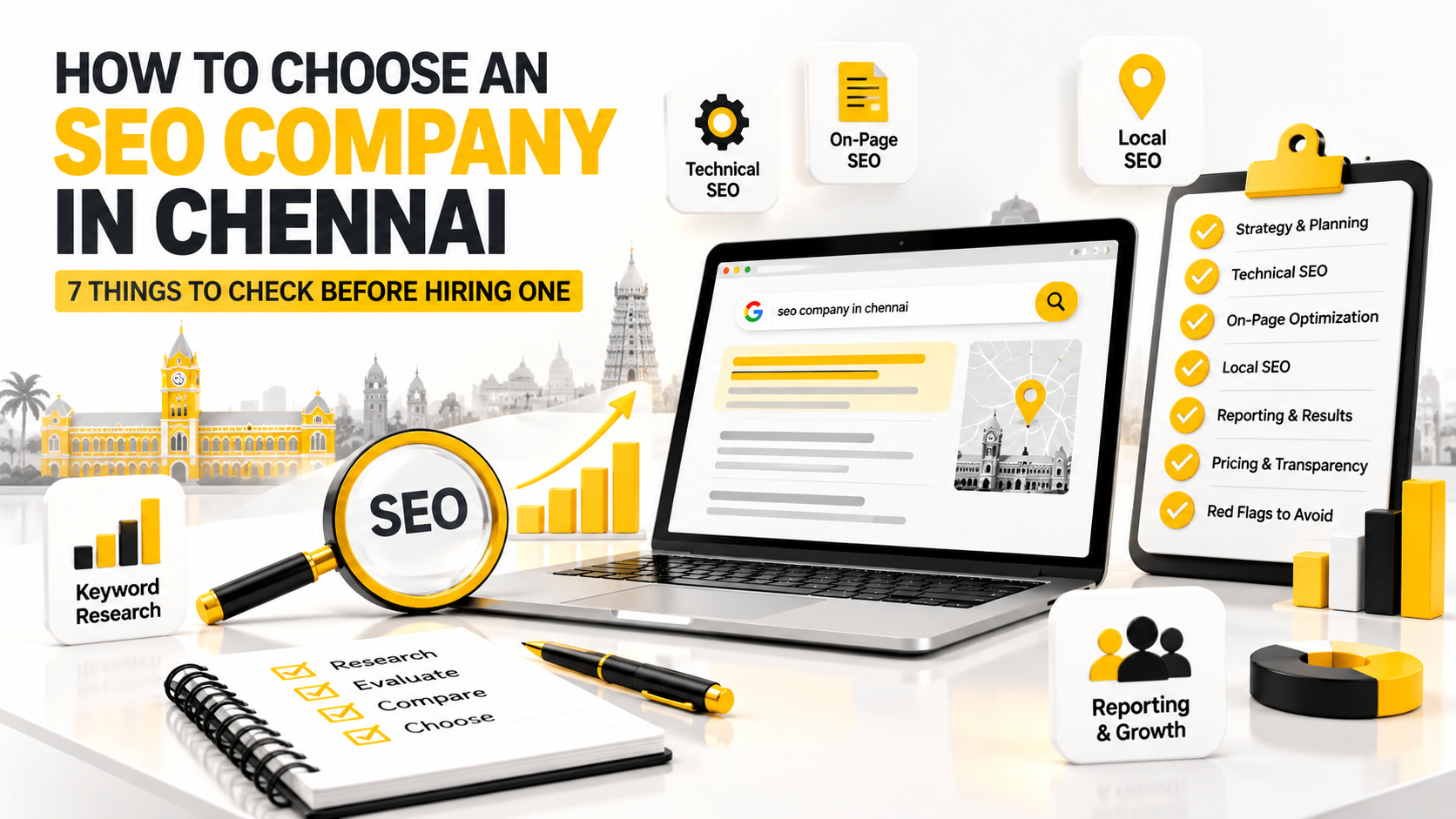
This guide covers seven important things to evaluate before hiring an SEO company in Chennai.
Businesses looking for professional implementation can explore our SEO services in Chennai, covering technical SEO, on-page optimization, local SEO, content strategy and organic search growth.
1. Check Whether They Understand Your Business Before Discussing Keywords
One of the first signs of a thoughtful SEO strategy is the questions an agency asks before recommending anything.
SEO should not begin with a random list of high-volume keywords.
A provider should first understand:
- What products or services you offer
- Which locations you serve
- Who your ideal customers are
- Which services generate the most revenue
- Who your main search competitors are
- Whether your priority is leads, sales, store visits or brand visibility
Only after understanding these factors should keyword research begin.
For example, a Chennai-based interior design company and a software development company may both want more organic traffic, but the search intent behind their potential customers is completely different.
The same applies to location. A business serving only Chennai may benefit from location-specific commercial keywords, while a company serving customers throughout India may require a broader strategy.
Search intent is also one of the fundamental reasons why one page can perform better than another. If you want to understand this process in more detail, read our guide on how search engines rank websites.
A good SEO provider should connect keyword research directly to business objectives rather than chasing search volume alone.
2. Understand What Their SEO Strategy Actually Includes
SEO is not a single activity.
Sustainable organic growth usually requires several areas of a website to work together.
Technical SEO
Technical SEO focuses on whether search engines can efficiently crawl, understand and index a website.
Common areas include:
- Crawlability
- Indexing
- XML sitemaps
- Robots directives
- Canonical tags
- Redirects
- Broken links
- Duplicate pages
- Mobile usability
- Page performance
- Structured data
Technical problems can limit organic visibility even when a website has strong content.
On-Page SEO
On-page optimization helps search engines and users understand the purpose of individual pages.
This can include improving:
- Page titles
- Meta descriptions
- H1 and subheadings
- Search intent alignment
- Content structure
- Internal linking
- Image alt text
- Relevant entities and topics
Good on-page SEO is not about repeating a keyword as many times as possible. The page should comprehensively satisfy the searcher's intent.
Businesses reviewing their existing pages can use this on-page SEO checklist for Chennai businesses to identify common optimization gaps.
Content Strategy
SEO content should have a clear purpose.
Some content targets people researching a topic, while other pages target users comparing providers or preparing to make a purchase.
A proper strategy maps different keywords to appropriate pages instead of creating multiple pages competing for the same search intent.
This distinction is particularly important because multiple pages targeting the same commercial query can make it harder for search engines to identify the most appropriate URL.
Off-Page SEO
Links and external mentions can help search engines understand the authority and reputation of a website.
However, quality matters more than simply accumulating large numbers of backlinks.
Relevant editorial links, legitimate business citations, industry mentions and useful content that naturally earns references are generally more sustainable than bulk link packages.
Before hiring an agency, ask what its SEO strategy actually includes instead of accepting a generic promise to "improve rankings."
3. Check How They Approach Local SEO
Local SEO can be particularly important for businesses serving customers within Chennai or specific areas of the city.
Someone searching for a service nearby may be much closer to contacting a business than someone conducting general research.
A local search strategy can involve:
- Google Business Profile optimization
- Accurate business information
- Relevant business categories
- Customer reviews
- Local citations
- Location-focused website content
- Local keyword research
- Google Maps visibility
- Local backlinks
- Consistent name, address and phone information
However, creating dozens of nearly identical location pages is not automatically an effective local SEO strategy.
Each location page should provide genuine value and make sense for the business.
For businesses serving areas such as Velachery, Nungambakkam, Anna Nagar, T. Nagar or Tambaram, the agency should determine whether dedicated location targeting is genuinely useful rather than automatically creating pages for every neighbourhood.
Our guide to local SEO for Chennai businesses explains how websites, Google Business Profile and other local signals can work together to improve local search visibility.
4. Look at What the Agency Actually Reports
SEO reports should help business owners understand whether the campaign is moving toward meaningful outcomes.
A report filled with hundreds of keyword positions may look impressive without explaining whether SEO is generating business.
Useful reporting may include:
- Organic clicks
- Search impressions
- Search queries
- Important keyword movements
- Organic landing-page performance
- Leads or enquiries
- Conversion performance
- Google Business Profile activity
- Technical issues resolved
- Content published or improved
- Links or citations acquired
Tools such as Google Search Console and Google Analytics can provide useful data for understanding organic search performance and user behaviour.
Most importantly, reporting should connect SEO activity with the original business objective.
If the objective is lead generation, an increase in traffic alone does not necessarily mean the campaign is succeeding.
The same principle applies across other marketing channels. Our guide on measuring digital marketing ROI explains why traffic, leads, conversions and business outcomes should be evaluated together.
Ask the provider what metrics will be monitored before the campaign begins.
5. Be Careful With Ranking Guarantees
One of the easiest SEO red flags to identify is an absolute ranking guarantee.
Statements such as:
"Guaranteed #1 position in 30 days"
should be approached carefully.
Search rankings depend on numerous factors, including competition, website history, content quality, technical health, authority, search intent and changes to Google's search systems.
An SEO company can control the work it performs.
It cannot directly control Google's organic rankings.
A more credible provider should explain:
- What needs improvement
- Which opportunities are realistic
- What will be prioritized first
- How progress will be monitored
- What factors could affect the timeline
SEO should therefore be evaluated as an ongoing growth process rather than a guaranteed ranking package.
6. Understand the Difference Between Affordable SEO and Cheap SEO
Budget matters, particularly for startups and small businesses.
But affordable SEO and cheap SEO are not necessarily the same thing.
An affordable campaign can reduce scope while still focusing on meaningful work.
For example, a smaller business might initially concentrate on:
- Fixing important technical problems
- Optimizing key service pages
- Improving local search visibility
- Creating a limited number of high-quality articles
- Strengthening internal links
- Tracking conversions correctly
A low-cost package becomes problematic when the reduced price depends on low-quality execution.
Watch for practices such as:
- Mass-produced content published without proper review
- Hundreds of irrelevant directory links
- Spam links
- Keyword stuffing
- Duplicate location pages
- Automated comments or forum links
- Reporting that focuses only on vanity metrics
Instead of asking only:
"How much does SEO cost?"
also ask:
"What exactly will be done for this budget?"
The second question provides much more useful information.
If budget is an important part of your decision, our detailed guide to SEO cost in Chennai explains how campaign scope, competition, locations and website requirements can influence pricing.
7. Ask How SEO Will Generate Leads, Not Just Traffic
Traffic is valuable only when it supports the objective of the website.
Imagine two SEO campaigns.
Campaign A generates 5,000 monthly organic visits but very few enquiries.
Campaign B generates 1,500 relevant visits and consistently produces qualified leads.
For a lead-generation business, Campaign B may provide considerably more business value.
This is why keyword intent matters.
Informational Searches
These users are primarily looking for information.
Examples might include:
- How does SEO work?
- What is technical SEO?
- How long does SEO take?
Informational content can build topical visibility and introduce potential customers to a brand.
Commercial Searches
These users are comparing solutions or providers.
Examples can include searches around agencies, pricing, services and comparisons.
Transactional Searches
These users may be closer to taking action, such as requesting a consultation, purchasing a product or contacting a service provider.
An effective SEO strategy can address multiple stages of this journey.
The important part is ensuring each keyword is mapped to the right type of page.
Blog posts should primarily educate.
Service pages should explain the service, establish trust and help qualified visitors take the next step.
This distinction also reduces the possibility of multiple pages on the same website competing for the same search intent.
How Long Should SEO Take?
There is no universal SEO timeline.
Results can depend on:
- Website age
- Existing authority
- Technical condition
- Competition
- Search demand
- Content quality
- Backlink profile
- Previous SEO work
- Frequency of implementation
A website with significant technical problems may need foundational work before substantial growth becomes visible.
An established website with existing authority may respond differently.
Instead of expecting a fixed number of months for every website, businesses should establish measurable milestones.
For example:
Early stage: Technical fixes, keyword mapping and content improvements.
Growth stage: Increasing impressions and visibility across relevant queries.
Later stage: Improving rankings, qualified organic traffic and conversions.
The timeline should be evaluated using actual search data rather than arbitrary promises.
Questions to Ask an SEO Company Before Hiring
A good consultation should give you enough information to understand how the agency thinks.
Consider asking:
How will you decide which keywords to target?
The answer should involve relevance, search intent, competition and business value—not search volume alone.
What will you change on my website?
The agency should be able to explain its technical and on-page priorities.
How do you build backlinks?
Avoid providers unwilling to explain where links come from.
How will you measure success?
The answer should extend beyond keyword rankings.
How often will I receive reports?
Understand what the report contains and how frequently progress will be reviewed.
Do you need access to Google Search Console and Analytics?
These platforms provide important first-party information for SEO measurement.
How will you handle an algorithm update?
Look for a data-driven response rather than promises of a secret recovery technique.
What happens during the first month?
A capable provider should be able to explain the initial audit, research and implementation process clearly.
Red Flags to Watch for Before Signing a Contract
No single warning sign proves an agency is unsuitable, but several together should encourage closer scrutiny.
Be cautious when a provider:
- Guarantees a specific Google position
- Promises unusually fast results without auditing the website
- Refuses to explain its backlink strategy
- Provides no access to performance data
- Publishes large quantities of low-quality content
- Focuses only on search volume
- Cannot explain search intent
- Sends reports without meaningful business metrics
- Uses the same strategy for every client
- Avoids discussing competitors
Transparency is especially important because SEO results accumulate over time.
Poor decisions can take considerably longer to correct than they took to implement.
Should Startups and Small Businesses Invest in SEO?
SEO can be useful for smaller businesses, but the strategy needs to reflect available resources and realistic opportunities.
A startup does not necessarily need to compete immediately for the highest-volume keyword in its industry.
It may begin with:
- Specific service keywords
- Local searches
- Long-tail searches
- High-intent queries
- Helpful niche content
- Google Business Profile optimization
This approach allows the website to establish relevance around a focused topic before expanding into more competitive areas.
SEO can also work alongside other channels such as paid advertising, social media, content marketing and website optimization. Businesses comparing a broader channel mix can explore Tecminion's digital marketing services in Chennai.
SEO Agency vs Freelancer: Which Should You Choose?
Neither option is automatically better.
The right choice depends on the scope of the project.
A freelancer may be suitable when a business needs focused support with one particular area, such as keyword research, content optimization or technical auditing.
An agency may be useful when the campaign requires several disciplines working together, such as:
- Technical SEO
- Content
- Local SEO
- Analytics
- Link acquisition
- Conversion optimization
- Development support
Rather than choosing based purely on the label "agency" or "freelancer," evaluate the expertise, process, communication and accountability available.
Final Thoughts
Choosing an SEO company in Chennai should not begin with promises about rankings.
Start with the business problem.
Determine who your customers are, what they search for, which pages should appear for those searches and what action visitors should take after reaching your website.
Then evaluate whether the SEO provider has a credible process for connecting those pieces.
Look for transparent reporting, sustainable techniques, realistic expectations and a strategy built around business outcomes rather than vanity metrics.
SEO takes time, but the right foundation can continue creating organic visibility long after individual optimizations are implemented.
The objective is not simply to find someone who "does SEO."
It is to find a provider with a strategy you understand, measurements you can verify and work that supports the long-term growth of your business.
If your business needs a team to handle technical optimization, content, local search and ongoing organic growth, explore Tecminion's professional SEO services in Chennai.
Frequently Asked Questions
What should I check before hiring an SEO company in Chennai?
Review the company's strategy, technical capabilities, content process, backlink methods, reporting, experience with local search and how it measures business outcomes. Avoid making the decision based only on price or ranking promises.
Can an SEO company guarantee first-page Google rankings?
No SEO provider directly controls Google's organic rankings. A company can improve technical health, content, relevance and authority, but exact positions depend on multiple factors, including competition and Google's search systems.
How do I know whether an SEO agency is doing good work?
Use measurable data. Google Search Console can show impressions, clicks and search queries, while analytics and conversion tracking can help determine whether organic visitors are generating useful business actions.
Is local SEO important for Chennai businesses?
It can be particularly valuable for businesses serving customers within specific geographic areas. Google Business Profile optimization, local content, reviews, citations and location relevance can all form part of a local SEO strategy.
Should a small business choose cheap SEO packages?
Price alone is not a reliable quality indicator. Smaller businesses can use a limited SEO budget effectively when the scope is prioritized carefully. The important question is what work will actually be performed within that budget.
Should SEO focus on traffic or leads?
It depends on the business objective, but lead-generation businesses should not judge SEO using traffic alone. Keyword intent, landing-page quality and conversion tracking should also be considered.
How long does SEO take to work?
There is no fixed timeline that applies to every website. Competition, technical condition, existing authority, content quality and the amount of work required can all affect how quickly meaningful improvements appear.
What is the difference between an SEO blog and an SEO service page?
A blog generally answers informational questions and helps users research a topic. A service page has commercial intent and explains the service, capabilities, evidence and next steps for potential customers.