
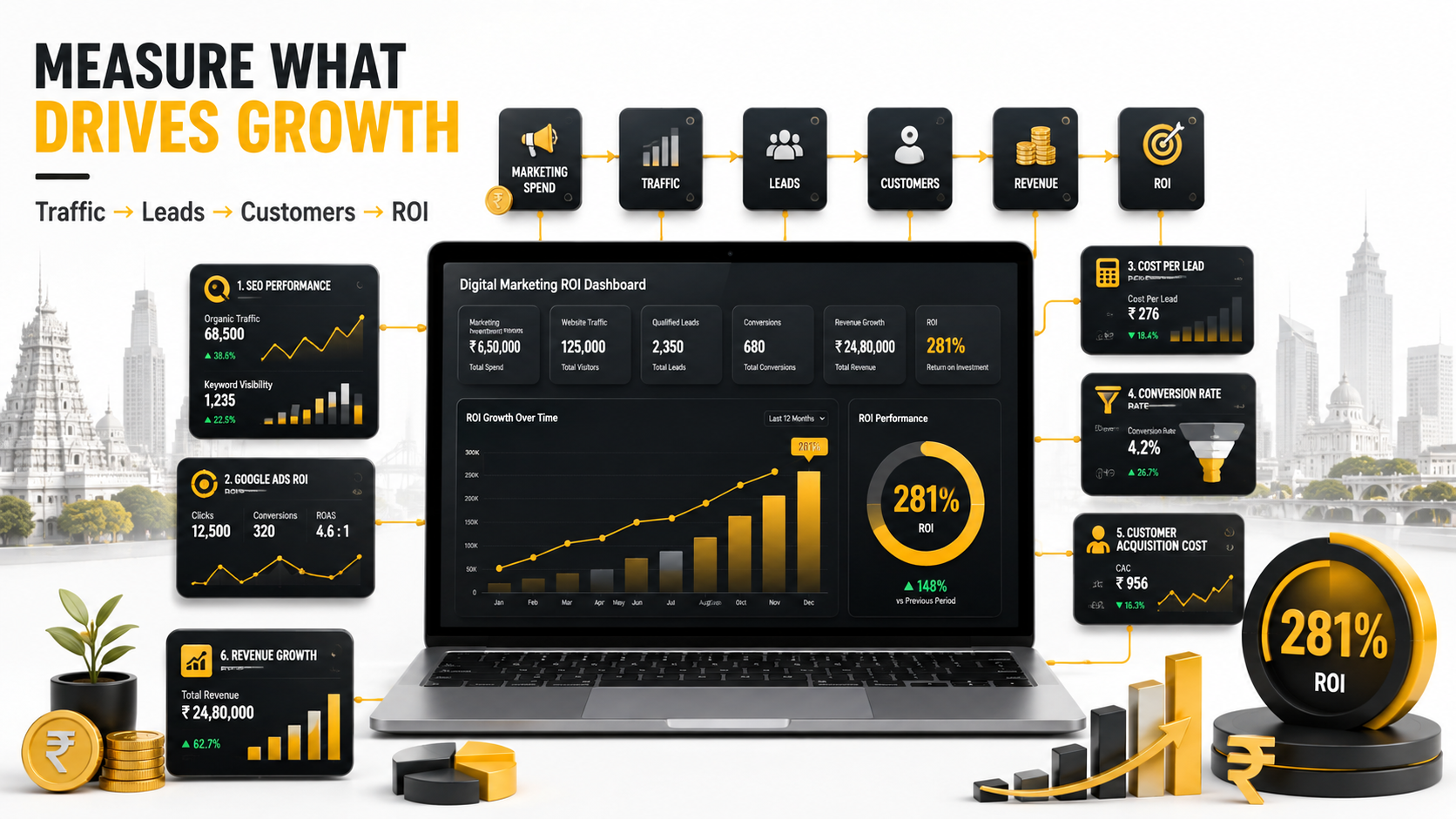
Running digital marketing campaigns is relatively easy. Measuring whether those campaigns are actually helping a business grow is where things become more challenging.
A Chennai business might invest in SEO, Google Ads, social media marketing, content creation, or other online marketing activities every month. Reports may show increasing website traffic, impressions, clicks, followers, and engagement. But these numbers alone do not tell the complete story.
The more important question is:
Is your digital marketing investment generating meaningful business results?
This is where Digital Marketing ROI becomes important.
Understanding return on investment helps businesses identify which marketing channels contribute to leads, customers, and revenue and which activities may need improvement.
For Chennai businesses operating in increasingly competitive markets, measuring marketing performance can help teams make smarter decisions about where to invest their time and budget.
In this guide, we will explain what digital marketing ROI means, how to calculate it, which metrics matter, and how businesses can evaluate SEO, paid advertising, social media, and other digital marketing activities more effectively.
What Is Digital Marketing ROI?
Digital Marketing ROI, or Return on Investment, measures the value a business receives from the money it spends on digital marketing.
At a basic level, it compares the revenue or value generated through marketing with the cost of running those marketing activities.
A simple formula is:
Digital Marketing ROI = (Revenue Generated − Marketing Cost) ÷ Marketing Cost × 100
For example, imagine a Chennai business spends ₹50,000 on a digital marketing campaign.
The campaign generates ₹1,50,000 in revenue.
The calculation would be:
(₹1,50,000 − ₹50,000) ÷ ₹50,000 × 100 = 200% ROI
This means the campaign generated a 200% return after accounting for the marketing investment.
However, real-world digital marketing measurement is often more complex.
Customers may discover a company through Google Search, read several blog posts, visit the website again through social media, and finally submit an enquiry after seeing a remarketing advertisement.
Because multiple channels can contribute to the same conversion, businesses should look beyond a single ROI number.
Why Measuring Digital Marketing ROI Matters for Chennai Businesses
Chennai has a diverse and competitive business environment.
Technology companies, real estate businesses, healthcare providers, educational institutions, manufacturers, retailers, restaurants, professional service providers, and startups are all competing for online visibility.
Simply spending more on marketing does not automatically create better results.
Businesses need to understand what is actually working.
Measuring ROI can help answer questions such as:
-
Which marketing channel generates the most qualified leads?
-
Is SEO contributing to long-term organic enquiries?
-
Are Google Ads producing profitable conversions?
-
Is social media generating business opportunities or only engagement?
-
Which landing pages convert visitors into enquiries?
-
Which keywords attract potential customers?
-
How much does it cost to acquire a new customer?
-
Which campaigns should receive more budget?
Without this information, marketing decisions can easily become based on assumptions rather than performance data.
Traffic Is Not the Same as Marketing Success
One of the most common mistakes in digital marketing measurement is treating website traffic as the primary measure of success.
Traffic is important, but traffic alone does not generate business growth.
Imagine two websites.
Website A receives 10,000 visitors per month and generates 20 enquiries.
Website B receives 3,000 visitors per month and generates 120 enquiries.
Website A has significantly more traffic.
But Website B may have the stronger digital marketing performance because its visitors are more relevant and more likely to become customers.
Instead of asking only:
“How much traffic did we receive?”
businesses should also ask:
“What happened after people reached our website?”
That change in perspective makes digital marketing measurement much more useful.
8 Important Metrics for Measuring Digital Marketing Success
There is no single metric that explains the complete performance of a digital marketing strategy.
Businesses should monitor several connected metrics.
1. Website Traffic
Website traffic shows how many users visit your website.
Businesses can analyse traffic from different channels, including:
-
Organic Search
-
Paid Search
-
Social Media
-
Direct Traffic
-
Referral Traffic
-
Email Marketing
Tracking traffic over time helps identify which channels are improving visibility.
For example, consistent growth in organic traffic may indicate that SEO efforts are beginning to improve search visibility.
However, traffic should always be evaluated alongside engagement, conversions, and lead quality.
2. Conversion Rate
Conversion rate measures the percentage of visitors who complete an important action.
A conversion could include:
-
Submitting a contact form
-
Making a phone call
-
Sending a WhatsApp enquiry
-
Requesting a quotation
-
Booking a consultation
-
Downloading a brochure
-
Registering for a service
-
Completing an online purchase
The formula is:
Conversion Rate = Conversions ÷ Total Visitors × 100
Suppose a website receives 2,000 visitors and generates 100 enquiries.
The conversion rate would be:
100 ÷ 2,000 × 100 = 5%
Conversion rate provides more context than traffic alone because it shows whether visitors are actually taking meaningful actions.
3. Cost Per Lead (CPL)
Cost Per Lead tells businesses how much they spend to generate one lead.
The formula is:
CPL = Total Marketing Spend ÷ Number of Leads
For example:
Marketing spend: ₹60,000
Leads generated: 120
₹60,000 ÷ 120 = ₹500 per lead
CPL is particularly useful when evaluating paid campaigns such as Google Ads and Meta Ads.
However, the cheapest lead is not necessarily the best lead.
A campaign producing ₹300 leads that rarely become customers could be less valuable than another campaign producing ₹800 leads with a much higher sales conversion rate.
Therefore, lead quality should always be considered.
4. Customer Acquisition Cost (CAC)
Customer Acquisition Cost measures how much a business spends to acquire an actual customer.
This is different from Cost Per Lead.
A lead has shown interest.
A customer has completed a purchase or signed up for a service.
The simplified formula is:
CAC = Total Sales and Marketing Cost ÷ New Customers Acquired
For example:
A company spends ₹1,00,000 on marketing and sales activities and gains 20 customers.
CAC = ₹5,000 per customer
Businesses can compare CAC with the average revenue or lifetime value generated by each customer.
This helps determine whether customer acquisition is financially sustainable.
5. Lead-to-Customer Conversion Rate
Generating leads is only part of the process.
Businesses should also understand how many leads become paying customers.
For example:
100 leads generated
15 customers acquired
The lead-to-customer conversion rate is:
15 ÷ 100 × 100 = 15%
This metric is particularly useful when evaluating lead quality.
If a campaign generates hundreds of enquiries but very few become customers, there may be problems with:
-
Audience targeting
-
Search intent
-
Landing page messaging
-
Pricing
-
Lead qualification
-
Sales follow-up
Marketing and sales performance should therefore be evaluated together.
6. Revenue Generated from Marketing
Ultimately, businesses need to understand whether marketing contributes to revenue.
Tracking revenue becomes easier for e-commerce businesses because online transactions can often be connected directly with marketing channels.
For service businesses, the process may require connecting website enquiries with CRM or sales data.
Businesses can track:
Marketing Source → Lead → Sales Opportunity → Customer → Revenue
This provides a much clearer picture of marketing performance than simply reporting clicks or impressions.
7. Customer Lifetime Value
Some customers generate value beyond their first purchase.
This is particularly important for businesses offering:
-
Subscription services
-
IT services
-
Maintenance contracts
-
SaaS products
-
Professional services
-
Repeat-purchase products
Customer Lifetime Value estimates the total value a customer may generate throughout their relationship with the business.
A marketing campaign with a relatively high acquisition cost may still be profitable when customers continue purchasing for several years.
Therefore, evaluating ROI only from the first transaction can sometimes underestimate the real value of marketing.
8. Return on Ad Spend (ROAS)
For paid advertising, businesses often monitor Return on Ad Spend.
The basic formula is:
ROAS = Revenue Generated from Ads ÷ Advertising Spend
For example:
Google Ads spend: ₹40,000
Revenue attributed to ads: ₹2,00,000
ROAS:
₹2,00,000 ÷ ₹40,000 = 5
This represents a 5:1 ROAS.
In other words, ₹5 in revenue was generated for every ₹1 spent on advertising.
ROAS is useful, but businesses should remember that advertising costs are not the only expenses involved in acquiring and serving customers.
How to Measure SEO ROI
SEO ROI can be more difficult to measure than paid advertising because SEO is generally a long-term investment.
A business may invest in:
-
Keyword research
-
Technical SEO
-
On-page optimization
-
Content creation
-
Local SEO
-
Internal linking
-
Website improvements
-
Digital authority building
The benefits of these activities can accumulate over time.
For example, a useful service page or blog article may continue generating organic traffic months after it was originally published.
Businesses evaluating SEO services in Chennai should therefore avoid judging performance only by short-term keyword movement.
Instead, monitor trends such as:
Organic Impressions → Rankings → Organic Clicks → Relevant Visitors → Leads → Customers → Revenue
Important SEO metrics include:
-
Organic search impressions
-
Organic clicks
-
Keyword visibility
-
Non-branded search traffic
-
Landing page performance
-
Organic conversions
-
Calls from organic visitors
-
Form submissions
-
Qualified organic leads
-
Revenue from organic customers
Tools such as Google Search Console and Google Analytics can help businesses understand different parts of this journey.
Rankings Matter, But Rankings Are Not the Final Goal
Keyword rankings are an important SEO metric, but ranking itself does not necessarily produce business value.
Suppose a Chennai company ranks #1 for a keyword that receives very little relevant search demand.
That ranking may look impressive in an SEO report but generate almost no enquiries.
Meanwhile, another keyword ranking in position #4 might consistently bring qualified prospects to the website.
Therefore, SEO performance should not be evaluated with rankings alone.
The better question is:
Are our search rankings bringing the right potential customers to the website?
Effective SEO connects visibility with business intent.
How to Measure Google Ads ROI
Google Ads can provide faster performance data because businesses can measure clicks and conversions soon after launching campaigns.
Important metrics include:
-
Impressions
-
Click-Through Rate
-
Cost Per Click
-
Conversion Rate
-
Cost Per Conversion
-
Search Terms
-
Qualified Leads
-
Conversion Value
-
ROAS
-
Customer Acquisition Cost
However, one of the biggest mistakes businesses make is optimizing Google Ads only for clicks.
A campaign receiving 1,000 clicks is not necessarily better than one receiving 300 clicks.
The smaller campaign could generate more qualified enquiries.
Businesses should analyse the entire path:
Keyword → Search Query → Advertisement → Landing Page → Enquiry → Qualified Lead → Sale
This helps identify exactly where campaign performance can be improved.
How to Measure Social Media Marketing ROI
Social media performance is often measured using:
-
Followers
-
Likes
-
Comments
-
Shares
-
Reach
-
Video views
These metrics can help measure audience engagement and brand visibility, but they should not always be treated as direct business outcomes.
For businesses using social media for lead generation, additional metrics should include:
-
Website visits from social channels
-
Direct enquiries
-
Lead form submissions
-
Cost per lead
-
Qualified leads
-
Sales generated
-
Assisted conversions
A post receiving 50,000 views but generating no meaningful action may have strong awareness value but limited direct lead-generation value.
The appropriate measurement depends on the original objective of the campaign.
How to Measure Content Marketing ROI
Content marketing can influence customers much earlier in their buying journey.
For example, someone might search:
“How much does SEO cost in Chennai?”
They find an educational blog article.
After reading it, they explore the company's services, leave the website, return several days later through Google, and then request a consultation.
The blog may not receive direct credit for the final conversion, but it contributed to the customer's decision.
Businesses should therefore monitor:
-
Organic traffic to content
-
Search impressions
-
Keyword visibility
-
Engagement
-
Internal link clicks
-
Assisted conversions
-
Leads influenced by content
-
Pages users visit after reading a blog
Good content should not exist simply to generate page views.
It should help potential customers move from information to consideration and eventually action.
Measuring Local Digital Marketing Performance in Chennai
For businesses serving customers in specific Chennai locations, local performance deserves separate attention.
For example, businesses targeting areas such as:
-
Porur
-
Velachery
-
Guindy
-
Anna Nagar
-
T. Nagar
-
Tambaram
-
OMR
-
Adyar
-
Manapakkam
may receive leads through both their website and Google Business Profile.
Useful local marketing metrics include:
-
Google Maps visibility
-
Local keyword rankings
-
Business Profile interactions
-
Website visits
-
Phone calls
-
Direction requests
-
Local organic traffic
-
Reviews
-
Enquiries from target locations
Local visibility becomes particularly important for businesses where customers prefer nearby service providers.
Build a Simple Digital Marketing Measurement Framework
Businesses do not need dozens of complicated dashboards to understand performance.
A practical measurement framework can follow five stages.
Stage 1: Visibility
Measure whether people can discover the business.
Track:
-
Search impressions
-
Keyword visibility
-
Social reach
-
Ad impressions
Stage 2: Traffic
Measure whether visibility brings users to your digital properties.
Track:
-
Website visitors
-
Organic clicks
-
Paid clicks
-
Social referrals
Stage 3: Engagement
Understand what visitors do after arriving.
Track:
-
Landing page engagement
-
Pages visited
-
Important button clicks
-
Service page visits
-
Content interaction
Stage 4: Leads
Measure actions showing genuine business interest.
Track:
-
Contact forms
-
Calls
-
WhatsApp enquiries
-
Quote requests
-
Consultation bookings
Stage 5: Revenue
Connect qualified leads with actual sales.
Track:
-
Qualified leads
-
Customers acquired
-
Customer acquisition cost
-
Revenue
-
Customer lifetime value
-
ROI
This creates a simple marketing funnel:
VISIBILITY → TRAFFIC → ENGAGEMENT → LEADS → CUSTOMERS → REVENUE
The closer your measurement gets to revenue, the more useful the data becomes for business decisions.
Set Clear Goals Before Measuring ROI
ROI measurement becomes difficult when marketing begins without clear objectives.
Before launching a campaign, define what success should look like.
For example:
SEO Goal
Increase qualified organic enquiries from Chennai.
Google Ads Goal
Generate sales enquiries within an acceptable Cost Per Lead.
Social Media Goal
Build brand awareness and generate relevant website visits.
Content Marketing Goal
Increase organic visibility and move potential customers toward service pages.
Different channels can have different objectives.
They should not always be judged using exactly the same metrics.
Track the Right Conversions
Many businesses install Google Analytics but never configure meaningful conversions.
This creates a major measurement gap.
Important conversions might include:
-
Contact form submissions
-
Phone number clicks
-
WhatsApp clicks
-
Quote requests
-
Appointment bookings
-
Purchases
-
Demo requests
-
Brochure downloads
Tracking these actions helps connect marketing traffic with actual customer intent.
Without conversion tracking, businesses may know how many people visited the website but not how many visitors became potential customers.
Understand the Customer Journey
Modern customer journeys are rarely linear.
A potential customer may:
Search on Google → Read Blog → Visit Service Page → Leave → See Social Post → Search Brand Name → Return → Submit Enquiry
If only the final visit receives credit, several important marketing touchpoints may be ignored.
Businesses should therefore look at marketing performance as a connected ecosystem rather than treating every channel in isolation.
SEO, content marketing, social media, paid advertising, and remarketing can influence different stages of the buying journey.
This is why a complete digital marketing strategy is often more effective than running disconnected campaigns.
Common Digital Marketing ROI Mistakes Businesses Should Avoid
Focusing Only on Vanity Metrics
High impressions, followers, likes, and website visits may look impressive but do not automatically mean the campaign is profitable.
Connect these metrics with meaningful business actions.
Measuring Every Channel the Same Way
SEO and paid advertising operate differently.
Google Ads may produce measurable conversions quickly, while SEO and content marketing can create value over a longer period.
Use channel-appropriate metrics.
Ignoring Lead Quality
Generating 500 leads sounds impressive.
But if only five are relevant, the campaign may have serious targeting problems.
Track qualified leads, not just total leads.
Ignoring Sales Data
Marketing reports should eventually connect with actual customers and revenue whenever possible.
Otherwise, businesses may optimize campaigns for enquiries that never convert.
Expecting Immediate SEO ROI
SEO generally requires consistent optimization and time.
Short-term ranking fluctuations should not be used as the only measure of SEO performance.
Look at long-term trends in visibility, traffic, conversions, and revenue.
Not Tracking Conversions Correctly
Without proper conversion tracking, businesses may make decisions using incomplete information.
Analytics setup should therefore be treated as part of the marketing strategy rather than an optional technical task.
What Does a Good Digital Marketing ROI Look Like?
There is no universal ROI percentage that every Chennai business should target.
A good ROI depends on several factors, including:
-
Industry
-
Profit margins
-
Product or service price
-
Sales cycle
-
Customer lifetime value
-
Competition
-
Marketing channel
-
Business objectives
A real estate company selling high-value properties can afford a very different acquisition cost compared with a local restaurant.
Similarly, a B2B technology company may generate fewer leads than an e-commerce business, but each successful customer could be worth significantly more.
Instead of comparing ROI with random industry numbers, businesses should establish their own benchmarks and improve them consistently.
How Chennai Businesses Can Improve Digital Marketing ROI
Improving ROI does not always mean spending less.
Often, it means using the existing marketing budget more effectively.
Businesses can improve performance by:
-
Targeting keywords with stronger customer intent
-
Improving landing page relevance
-
Creating useful SEO content
-
Strengthening calls to action
-
Improving website speed and mobile usability
-
Optimizing Google Ads search terms
-
Removing irrelevant audience targeting
-
Improving conversion tracking
-
Testing advertisements and landing pages
-
Building stronger internal linking
-
Improving local SEO visibility
-
Following up with leads quickly
-
Tracking qualified leads and sales
Small improvements across several stages of the customer journey can create a significant overall impact.
For example:
Better Keywords → Better Traffic → Better Landing Page → More Qualified Leads → Higher Sales → Better ROI
Why an Integrated Digital Marketing Strategy Matters
Businesses sometimes treat SEO, PPC, social media, content marketing, and website optimization as completely separate activities.
In reality, these channels can support one another.
SEO helps customers discover the business through search.
Content answers questions and builds trust.
Google Ads captures immediate search demand.
Social media increases visibility and keeps the brand connected with its audience.
Landing page optimization converts visitors into enquiries.
Analytics helps identify which activities are producing results.
When these elements work together, businesses gain a clearer customer journey and stronger opportunities for growth.
For companies looking to coordinate these channels effectively, working with experienced Digital Marketing Services in Chennai can help create a strategy focused not only on online visibility, but also on measurable leads, conversions, and long-term business growth.
Final Thoughts
Digital marketing success should not be judged by rankings, clicks, followers, or traffic alone.
Those numbers are useful indicators, but they are only parts of a much larger picture.
Chennai businesses should focus on understanding the complete journey:
Visibility → Traffic → Engagement → Leads → Customers → Revenue
Once businesses start connecting marketing activity with qualified leads and sales, it becomes easier to understand which channels deserve more investment and which strategies need improvement.
Most importantly, measuring Digital Marketing ROI turns marketing from a collection of activities into a measurable business growth system.
The goal is not simply to generate more clicks.
The goal is to turn the right digital attention into measurable business results.