
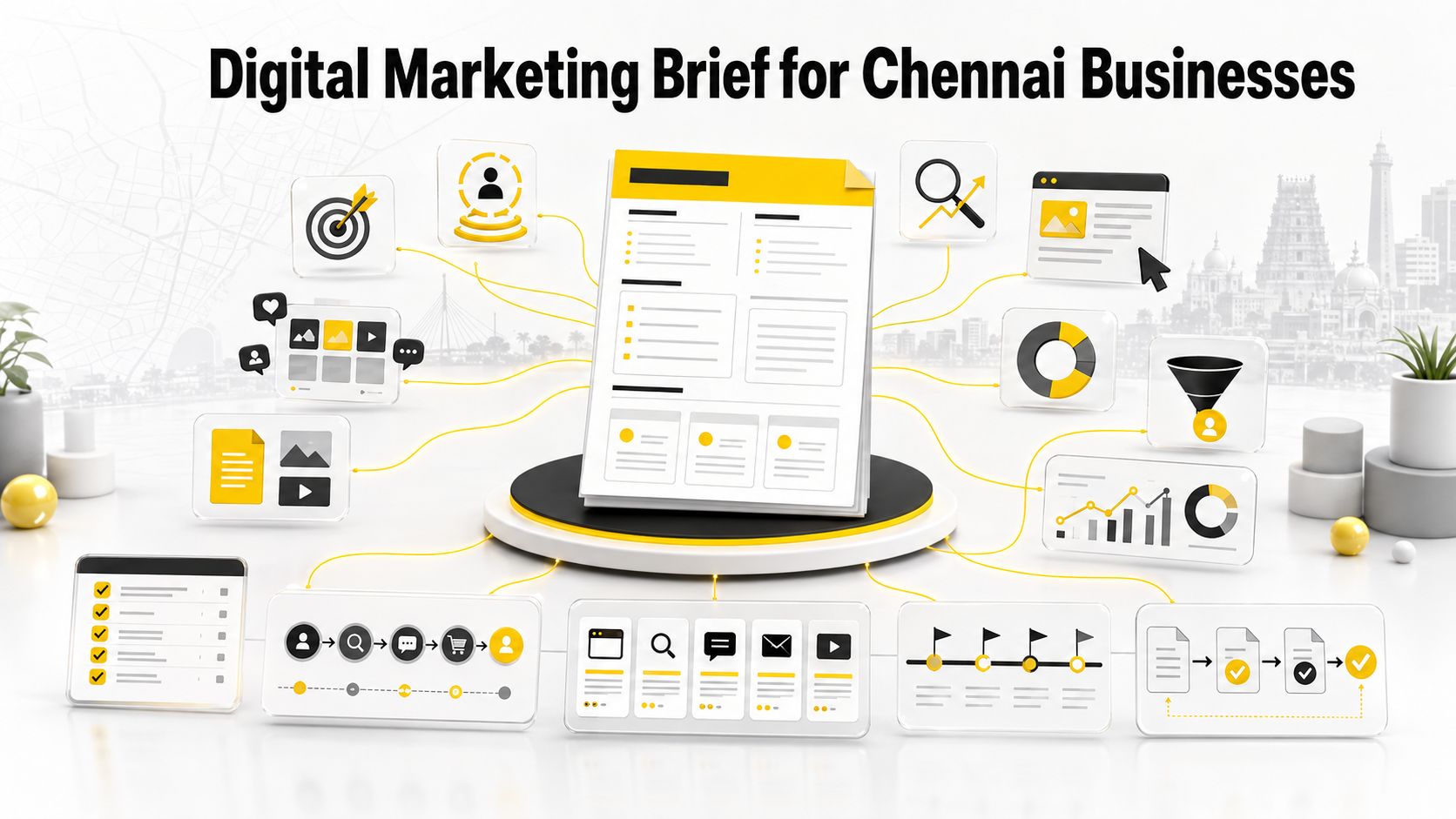
Digital marketing becomes difficult when a business begins without clearly defining what it wants to achieve. The marketing team may create content, launch advertisements and improve the website, but the campaign can still move in the wrong direction if the business goal, target audience and lead process are unclear.
A digital marketing brief solves this problem. It gives the marketing team the information required to understand the business, plan the right activities and measure meaningful results.
Before working with a digital marketing agency in Chennai, prepare a practical brief covering your business, customers, priorities, budget and expectations. It does not need complicated terminology. It needs accurate information that helps both sides make better decisions.
What Is a Digital Marketing Brief?
A digital marketing brief is a document that explains:
-
What the business offers
-
Who its ideal customers are
-
What marketing outcome it wants
-
Which products or services should receive priority
-
What budget and resources are available
-
How enquiries are managed
-
How campaign success will be measured
The brief acts as a shared reference for the business owner, marketing team, content writers, designers, developers and sales team.
Without it, different people may work toward different goals. A designer may focus on visual appearance, an advertising specialist may focus on clicks and the business owner may expect confirmed sales. A clear brief connects these activities to one agreed business outcome.
1. Provide a Clear Business Overview
Begin with a simple explanation of the business. Avoid depending only on company brochures or broad descriptions such as “we provide quality solutions.”
Include:
-
Your main product or service
-
Your operating locations
-
Your target industries or customer groups
-
Your primary revenue source
-
Your typical project or order value
-
Your usual sales cycle
-
Your genuine competitive advantages
-
Your major competitors
For example, “We are a real-estate company in Chennai” gives very little direction.
A more useful description would be:
We sell CMDA and RERA-approved residential plots in South Chennai to working professionals and families who want to construct a home within the next two years.
This version identifies the offer, location, customer and likely purchase intention.
2. Select One Primary Marketing Goal
Many businesses want more traffic, followers, leads, sales and brand awareness simultaneously. These may all be valid goals, but one objective should receive first priority.
Possible primary goals include:
-
Generate qualified enquiries
-
Increase appointment bookings
-
Improve local visibility
-
Increase online purchases
-
Generate software demo requests
-
Receive more property-site visit enquiries
-
Build organic search visibility
-
Improve repeat purchases from existing customers
The goal should be connected to a measurable business outcome.
Instead of writing “We need more online visibility,” use:
We want to generate 25 qualified consultation enquiries per month from businesses located in Chennai.
Once the main goal is clear, the marketing team can recommend the most relevant mix of digital marketing services instead of trying to use every available channel.
3. Describe the Ideal Customer
“Everyone who needs our service” is not a target audience.
The brief should describe the people or businesses most likely to purchase from you.
Include information such as:
-
Customer location
-
Customer type
-
Age range, if relevant
-
Income or budget range, if appropriate
-
Business size for B2B services
-
Job role of the decision-maker
-
Main customer problem
-
Purchase motivation
-
Common objections
-
Preferred communication method
-
Average decision-making period
A clinic may target patients living within a practical travelling distance. A B2B technology company may target operations managers or business owners. An e-commerce brand may focus on buyers interested in a specific product category rather than a broad national audience.
Detailed audience information makes keyword selection, advertisements, landing pages and content more relevant.
4. Explain the Customer’s Main Problem
Customers rarely search using the same language that appears in a corporate brochure. They normally search for a solution to a specific problem.
Examples include:
-
Our website is not generating enquiries
-
Our Google Ads leads are becoming expensive
-
Customers cannot find our business on Google Maps
-
Our social media posts are not reaching potential buyers
-
Our online store receives visitors but very few orders
-
Our sales team receives too many irrelevant leads
-
We do not know which marketing channel is producing sales
List the questions customers regularly ask during phone calls, WhatsApp conversations, meetings and email enquiries.
These questions can later be used for:
-
Website content
-
Blog topics
-
Search keywords
-
FAQ sections
-
Advertising messages
-
Videos
-
Lead-nurturing content
Content based on genuine customer concerns is usually more useful than content created only around broad keywords.
5. Identify the Priority Product or Service
If the business offers several services, do not ask the marketing team to promote everything equally from the beginning.
Identify:
-
The most profitable service
-
The service with the strongest current demand
-
The service with the best delivery capability
-
The service that needs immediate enquiries
-
The product or service with the clearest competitive advantage
The brief should explain what the customer receives, what is included, the approximate timeline and what action the customer should take next.
If pricing cannot be published, provide at least an internal price range to the marketing team. This helps prevent campaigns from attracting customers whose expectations are far below the actual cost.
6. Clarify the Geographic Target
Location is especially important for Chennai businesses.
Mention whether you serve:
-
All of Chennai
-
Specific areas within Chennai
-
Chennai and nearby districts
-
All of Tamil Nadu
-
Customers across India
-
International customers
-
Only customers within a practical travelling radius
A business located in Velachery may serve customers across Chennai, while a clinic or local shop may depend mainly on nearby areas.
Do not add every Chennai location to the brief merely to target more keywords. Include only the places the business can genuinely serve.
7. Explain Which Marketing Channels Have Priority
A business does not need to become active on every platform immediately. Channel selection should depend on how customers discover and evaluate the service.
SEO
Businesses whose customers actively search on Google can use SEO services in Chennai to build long-term visibility for relevant informational, local and commercial searches.
The brief should identify important services, customer questions, target locations and existing organic performance.
Google Ads
Businesses needing faster visibility for high-intent searches can consider Google Ads services in Chennai.
The brief should include the advertising budget, priority service, target location, lead value and negative customer types. This helps reduce irrelevant clicks and enquiries.
Social Media
Visual, lifestyle and community-focused businesses may benefit from social media marketing services.
The brief should explain the target audience, brand tone, content approval process, available images and the action users should take after viewing the content.
Content Marketing
Businesses with complex products or longer sales cycles need a structured content marketing strategy.
Useful content can answer customer questions, support service pages, help the sales team and build trust before an enquiry is submitted.
Select two or three priority channels first. Additional channels can be introduced after the tracking and lead-handling process is working correctly.
8. Share Existing Marketing Data
Past marketing data helps the new team understand what has already been attempted.
Share available information from:
-
Google Search Console
-
Google Analytics
-
Google Ads
-
Meta Ads
-
Google Business Profile
-
Customer relationship management software
-
Call reports
-
Sales records
-
Email platforms
-
Previous agency reports
Important information includes:
-
Channels that generated qualified leads
-
Campaigns that attracted irrelevant enquiries
-
Pages that generated leads
-
Search terms that brought potential customers
-
Average lead-to-sale rate
-
Average customer value
-
Seasonal changes in demand
-
Locations that produced better enquiries
Do not hide failed campaigns. Unsuccessful campaigns can reveal useful information about targeting, messaging, website experience or follow-up problems.
9. List the Available Marketing Assets
The brief should include an inventory of existing marketing materials.
Examples include:
-
Website
-
Brand logo
-
Brand colours and fonts
-
Product photographs
-
Project images
-
Customer testimonials
-
Case studies
-
Videos
-
Brochures
-
Presentations
-
Email database
-
Existing blog articles
-
Customer FAQs
-
Sales scripts
-
Google Business Profile
-
Social media accounts
Mention whether the business has permission to use client names, photographs, testimonials and results.
Only genuine testimonials and verifiable results should be used. If customer approval is unavailable, use factual and anonymous project information without exposing private details.
10. Describe the Enquiry and Sales Process
Marketing performance cannot be evaluated correctly without understanding what happens after an enquiry is received.
The brief should answer:
-
Who receives the lead?
-
How quickly is the lead contacted?
-
Is the customer contacted through phone, email or WhatsApp?
-
How is the lead qualified?
-
How many follow-ups are completed?
-
Where is the lead status recorded?
-
How is a qualified lead defined?
-
How are confirmed sales reported to the marketing team?
-
What happens to customers who are not ready to buy immediately?
A campaign may generate valid enquiries but still appear unsuccessful when the response is delayed or the sales outcome is not recorded.
The marketing and sales teams should agree on the meaning of a qualified lead before the campaign begins.
11. Define the Conversion Action
Every campaign needs a clear next step.
Depending on the business, the conversion action may be:
-
Submit an enquiry form
-
Call the business
-
Start a WhatsApp conversation
-
Book an appointment
-
Request a quotation
-
Schedule a demonstration
-
Download a guide
-
Purchase a product
-
Request a site visit
Avoid placing several competing actions on the same landing page without a clear priority.
Before launching the campaign, test the form, phone number, WhatsApp button, success message and analytics tracking. A broken enquiry path can waste both organic traffic and advertising spend.
12. Set Meaningful Success Metrics
Do not measure campaign success only through followers, impressions or website visitors.
The brief should identify business-focused metrics such as:
-
Qualified enquiries
-
Appointment bookings
-
Phone calls
-
WhatsApp conversations
-
Product purchases
-
Conversion rate
-
Cost per qualified lead
-
Lead-to-customer rate
-
Revenue influenced by marketing
-
Organic clicks from relevant searches
-
Returning customers
-
Customer acquisition cost
Supporting metrics such as impressions, rankings, clicks and engagement are still useful. However, they should be evaluated alongside enquiries, sales quality and business outcomes.
13. Mention the Available Budget
Provide a realistic budget range rather than asking the team to recommend everything without financial context.
Separate the expected costs into:
-
Marketing service fee
-
Advertising spend
-
Website or landing-page work
-
Content creation
-
Photography or video production
-
Design requirements
-
Marketing software
-
Testing budget
The available budget affects channel selection, geographic targeting, content quantity and campaign speed.
A smaller focused campaign is often easier to evaluate than spreading a limited budget across too many platforms.
14. Define the Approval Process
Campaigns are frequently delayed because responsibilities are unclear.
The brief should state who can approve:
-
Marketing strategy
-
Blog content
-
Social media content
-
Advertisements
-
Images and videos
-
Website changes
-
Promotional offers
-
Budget increases
Also include:
-
Expected approval time
-
Preferred communication channel
-
Emergency contact
-
Final decision-maker
-
People who should receive reports
A clear approval system reduces repeated changes and prevents outdated offers from remaining live.
15. Include Brand and Compliance Restrictions
List any conditions the marketing team must follow.
These may include:
-
Words or claims that cannot be used
-
Mandatory disclaimers
-
Industry regulations
-
Geographic restrictions
-
Customer-data requirements
-
Brand tone
-
Logo usage rules
-
Offers that require approval
-
Services that must not be advertised
-
Client information that must remain confidential
Healthcare, finance, insurance, education and real-estate businesses may need additional care around advertising claims, customer information and approvals.
16. Set a Realistic Timeline
Different marketing channels operate at different speeds.
The brief should include:
-
Website preparation deadline
-
Tracking setup date
-
Campaign launch date
-
Content publishing schedule
-
Weekly review process
-
Monthly reporting date
-
Initial evaluation period
-
Sales-feedback schedule
SEO normally requires consistent work and time to build visibility. Paid advertising may begin generating traffic sooner, but campaign targeting and conversion quality still require testing.
Avoid setting deadlines based only on when the business wants results. Competition, website quality, budget, customer demand and sales-cycle length must also be considered.
Digital Marketing Brief Checklist
Before sharing the brief, confirm that it includes:
-
Business overview
-
Primary marketing goal
-
Ideal customer
-
Customer problems
-
Priority product or service
-
Target locations
-
Competitive advantages
-
Priority marketing channels
-
Existing performance data
-
Available marketing assets
-
Lead-handling process
-
Primary conversion action
-
Success metrics
-
Budget range
-
Campaign timeline
-
Approval contacts
-
Brand restrictions
-
Compliance requirements
-
Reporting expectations
Final Thoughts
A digital marketing brief does not need complicated language or a large number of pages. It needs clear, honest and useful information.
When the business goal, customer, offer, budget, conversion action and responsibilities are clearly defined, the marketing team can build a focused strategy. The business owner can also evaluate performance more accurately because everyone is working toward the same measurable outcome.
Before launching another campaign, take time to prepare the brief. A well-structured brief can reduce confusion, improve collaboration and create a stronger foundation for sustainable business growth.