
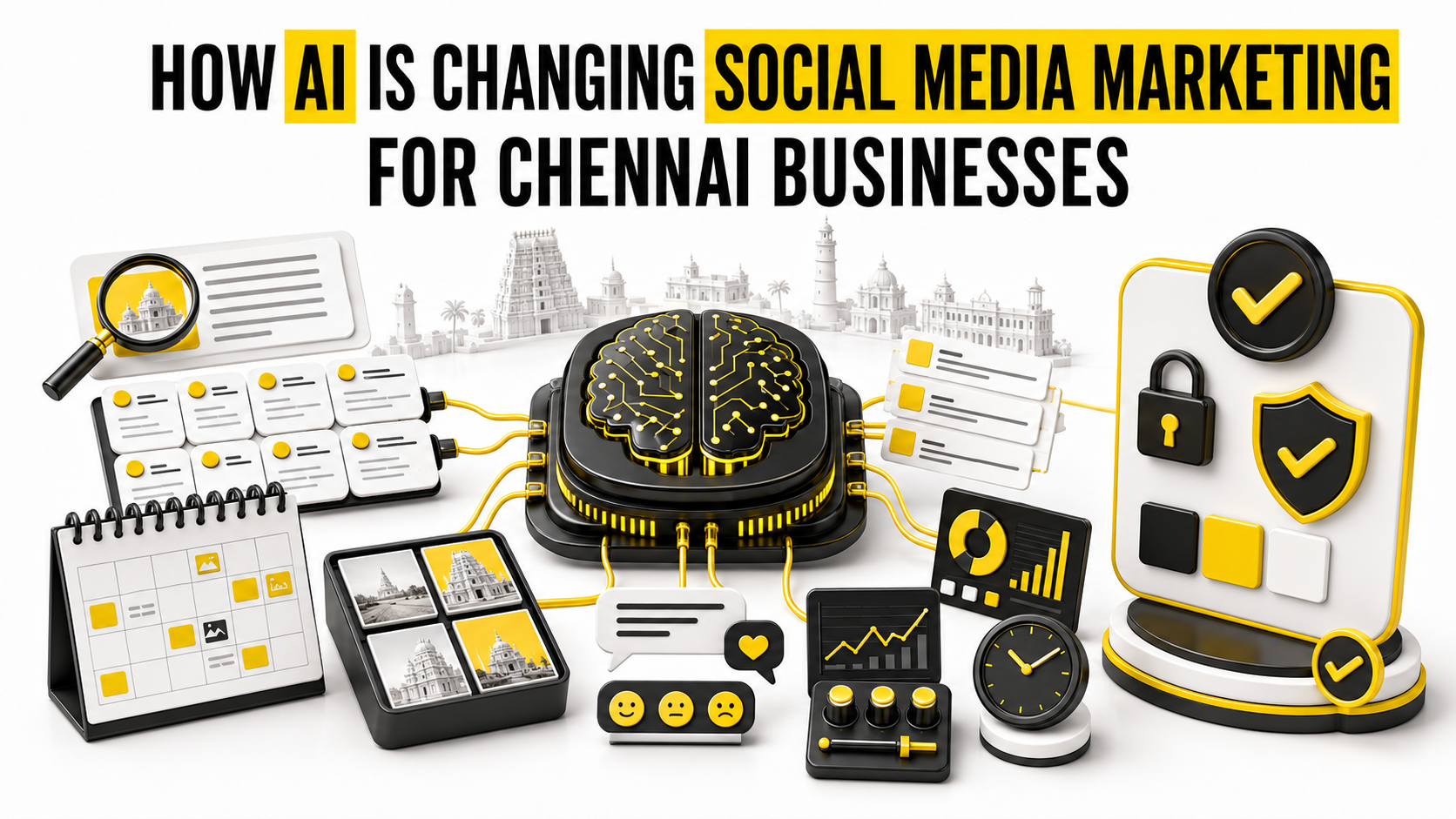
Social media marketing used to follow a fairly predictable routine. A business would plan a monthly calendar, create a set of posts, publish them across a few platforms and check basic metrics such as likes, comments and reach.
That process still exists, but artificial intelligence is changing how quickly marketing teams can research ideas, understand audience behaviour, produce content and improve campaigns.
For a Chennai business, this does not mean handing the entire social media presence over to an AI tool. It means using technology to reduce repetitive work while allowing people to concentrate on strategy, creativity and customer relationships.
A restaurant in Velachery, a clinic in Anna Nagar and a property developer in OMR may all use social media, but their audiences, buying journeys and content requirements are completely different. AI can support these businesses, but it still needs proper context and human direction to produce useful results.
Where AI Fits into Social Media Marketing
Artificial intelligence can analyse information, identify patterns and generate suggestions much faster than a person working manually. In social media marketing, it can assist with tasks such as:
-
Finding content ideas
-
Drafting captions
-
Organising content calendars
-
Understanding audience questions
-
Reviewing campaign performance
-
Identifying common customer sentiment
-
Producing creative variations
-
Automating routine responses
-
Improving advertisement targeting and testing
The important word is “assist.”
AI works best as a supporting system. It can help a team move faster, but it cannot independently understand a business, its customers and its reputation with the same depth as the people running it.
AI Can Make Content Research Faster
One of the most time-consuming parts of social media management is deciding what to publish consistently.
Businesses often repeat the same promotional messages because they run out of ideas. A real estate company may continuously post property images. A clinic may share only treatment offers. A training institute may keep promoting admissions without answering the questions students have before enrolling.
AI-assisted research can help uncover broader content opportunities.
For example, a Chennai real estate company could organise its social content into topics such as:
-
Home-buying questions
-
Locality comparisons
-
Documentation guidance
-
Construction updates
-
Customer stories
-
Site-visit preparation
-
Loan and budgeting basics
Similarly, a restaurant could build content around signature dishes, preparation methods, customer occasions, local food preferences and behind-the-scenes processes.
AI can generate the initial list quickly. The marketing team must then decide which ideas are accurate, useful and suitable for the brand.
Caption Writing Becomes More Efficient
Writing a fresh caption for every post can take considerable time, especially when a business publishes across Instagram, Facebook and LinkedIn.
AI tools can prepare initial caption variations based on the platform, target audience and desired action. One version may be short and conversational for Instagram, while another may be more informative for LinkedIn.
However, directly publishing the first AI-generated caption is rarely a good idea.
Generic AI captions often include:
-
Unnecessary emojis
-
Repetitive phrases
-
Exaggerated claims
-
Formal language that does not match the brand
-
Weak calls to action
-
Information that sounds correct but has not been verified
The better workflow is to provide the AI system with actual business information, generate a draft and then edit it manually.
A Chennai brand may also communicate using a natural mix of English and Tamil. AI can help draft bilingual content, but a person familiar with local language usage should review it. Direct translations frequently sound unnatural and may miss the tone customers expect.
AI Supports Creative Planning, Not Just Writing
Social media performance depends on visuals as much as captions. AI can help marketing teams explore different creative directions before a designer begins production.
For example, a digital marketing team could generate concepts for:
-
Educational carousels
-
Before-and-after comparisons
-
Process-based infographics
-
Customer-journey visuals
-
Frequently asked question posts
-
Product-use demonstrations
-
Seasonal campaign creatives
This gives the designer a clearer starting point and can reduce time spent developing initial concepts.
Still, visual consistency must be controlled by the brand. Colours, fonts, image style, logo placement and messaging should follow an established identity. Publishing unrelated AI-generated visual styles every week can make the business look inconsistent and less trustworthy.
Audience Questions Can Guide the Content Calendar
Good social media content answers questions customers actually have.
AI can help organise customer questions collected from:
-
WhatsApp conversations
-
Sales calls
-
Website enquiries
-
Social media comments
-
Google Business Profile questions
-
Customer-support messages
A marketing team can group these questions by topic and use them to build a practical content calendar.
For example, a Chennai clinic may repeatedly receive questions about appointment timings, preparation for a procedure, recovery time and insurance acceptance. Instead of publishing only general health tips, the clinic can create posts that answer these real questions clearly.
This approach makes content more useful because it begins with customer needs rather than an arbitrary posting schedule.
Customer information must be handled carefully. Names, phone numbers, medical details, financial information and private conversations should never be copied into public AI systems without appropriate safeguards and permission.
Social Listening and Sentiment Analysis
As a business grows, manually reviewing every mention, comment and review becomes difficult. AI-assisted social listening tools can help categorise conversations as positive, negative, neutral or urgent.
This can help a business identify:
-
Common customer complaints
-
Questions that appear repeatedly
-
Products receiving positive feedback
-
Sudden changes in public sentiment
-
Issues that require a quick response
-
Topics attracting stronger engagement
Imagine that several customers mention slow delivery within the same week. The issue may not be obvious if each comment is viewed separately. A sentiment system can reveal the repeated pattern, allowing the business to investigate quickly.
AI should not automatically handle sensitive complaints without supervision. An upset customer requires empathy and an accurate response, not a generic automated apology.
Scheduling and Workflow Automation
Social media management includes many repetitive operational tasks. Posts need approvals, creatives must be organised, captions have to be checked and content must be scheduled at the correct time.
AI-supported workflow tools can help:
-
Arrange posts by campaign
-
Suggest publishing schedules
-
Identify missing creative assets
-
Convert long content into platform-specific drafts
-
Maintain approval checklists
-
Summarise weekly performance
Automation becomes especially useful for businesses managing several services or locations.
But businesses should not publish the same content on every platform without adaptation. Someone browsing Instagram may respond to a short visual story, while a LinkedIn audience may expect a detailed professional explanation. Efficient distribution should not become identical distribution.
Businesses that are uncertain where to focus can begin by choosing the right social media platform for a Chennai business before investing time in complex automation.
AI Can Improve Social Media Advertising
AI also plays an important role in paid social campaigns. Advertising platforms use machine learning to assist with audience discovery, delivery, creative testing and campaign optimisation.
Marketing teams can use AI to prepare multiple variations of:
-
Headlines
-
Primary text
-
Offers
-
Visual concepts
-
Calls to action
-
Landing-page messages
These variations can then be tested using real campaign data.
However, more variations do not automatically create better results. A campaign still requires:
-
A clear business objective
-
Accurate conversion tracking
-
A relevant audience
-
A strong offer
-
Suitable creative
-
A functional landing page or WhatsApp process
-
Regular lead-quality review
An automated campaign may generate many cheap enquiries that never become customers. Businesses should evaluate qualified leads, appointments, sales and revenue rather than judging success only through clicks or messages.
What AI Should Not Replace
AI can speed up execution, but certain responsibilities should remain human-led.
Brand positioning
A tool can suggest wording, but it cannot independently decide what a business should represent in the market.
Strategic decisions
Choosing an audience, campaign objective, budget or offer requires business knowledge and accountability.
Customer relationships
Important enquiries, complaints and sales conversations need genuine attention.
Factual approval
Prices, availability, service claims, legal information and technical details must be verified before publishing.
Local understanding
Chennai is not one uniform market. Customer behaviour may differ between Velachery, Anna Nagar, Porur, OMR, Tambaram and other areas. Local context cannot be added effectively through a city name alone.
Original experience
Real project outcomes, customer insights and lessons from completed campaigns are more valuable than generic AI-generated advice.
The Risk of Generic AI Content
When many businesses use similar tools with similar prompts, their content begins to look identical.
Common signs include:
-
Predictable introductions
-
Repeated motivational phrases
-
Excessive lists
-
Identical post structures
-
Vague advice without examples
-
Claims unsupported by experience
-
Captions that could belong to any company
Publishing more of this content may increase posting frequency without building trust.
A smaller number of useful, distinctive posts is often more valuable than publishing generic content every day. Before approving a post, businesses should ask:
-
Does this contain information specific to our customers?
-
Is every claim accurate?
-
Does the tone sound like our business?
-
Does the post help someone make a decision?
-
Is there a clear reason for publishing it?
If the answer is no, the content requires further editing.
A Practical AI Workflow for Chennai Businesses
Businesses do not need a complicated technology stack to start using AI responsibly. A simple workflow is enough.
Step 1: Choose one business objective
Examples include increasing store visits, generating appointments, receiving qualified enquiries or building awareness for a new service.
Step 2: Define the audience
Document the customer’s location, needs, concerns and stage in the buying journey.
Step 3: Collect genuine source material
Use approved information from the website, service documents, customer questions, campaign data and team knowledge.
Step 4: Use AI for assistance
Generate topic clusters, initial outlines, caption alternatives and creative ideas.
Step 5: Add local and brand context
Include real examples, service details, customer concerns and relevant Chennai context.
Step 6: Complete human review
Check facts, language, tone, privacy, spelling and visual consistency.
Step 7: Publish and measure
Monitor meaningful outcomes such as qualified enquiries, calls, appointments, website visits and conversions.
Step 8: Improve using evidence
Repeat topics that attract the right audience. Rewrite or discontinue content that creates reach without meaningful engagement.
Businesses that need consistent planning, creative production and campaign measurement can use professional social media marketing services in Chennai while keeping their internal team involved in approvals and customer insights.
Final Thoughts
AI is not removing the need for social media marketers. It is changing where their time is most valuable.
Routine research, initial drafts, data organisation and creative variations can become faster. This allows marketers to spend more time understanding customers, developing campaigns, reviewing lead quality and improving business results.
For Chennai businesses, the best approach is not complete automation. It is a balanced system in which AI handles repetitive assistance while people retain control over strategy, facts, creativity and customer communication.
The businesses that benefit most will not necessarily be those using the greatest number of AI tools. They will be the ones using AI with clear objectives, reliable information, strong human review and a genuine understanding of the audience they want to reach.
Frequently Asked Questions
Can small businesses use AI for social media marketing?
Yes. Small businesses can use AI for content research, caption drafts, calendar planning and performance summaries. They should begin with one clear use case instead of adopting several tools at once.
Can AI completely manage a social media account?
AI can automate parts of the workflow, but complete unsupervised management is risky. Strategy, factual approval, customer conversations and reputation-sensitive responses still require human involvement.
Will AI-generated social media content affect brand quality?
It can affect quality if content is published without editing. AI drafts should be revised using the brand’s tone, actual experience and accurate business information.
How can Chennai businesses make AI content feel local?
Use genuine customer questions, relevant neighbourhood or service-area context, local buying concerns and natural language. Simply adding “Chennai” repeatedly does not make content locally useful.
Is AI useful for social media advertisements?
Yes. It can help develop and test creative variations, but campaign success still depends on the offer, audience, tracking, landing experience and quality of the leads generated.