
Launching a startup is exciting, but marketing it can quickly become confusing. Should you invest in SEO, Google Ads, social media, content marketing or all of them at once?
Many Chennai startups begin by opening accounts on every platform, publishing irregularly and running small advertising campaigns without clear tracking. This creates activity, but it does not always produce useful business results.
A better approach is to treat the first 90 days as a structured learning period. During this time, your goal is not simply to generate more traffic. You need to understand who your ideal customers are, how they discover your business and which marketing activities are most likely to produce qualified enquiries.
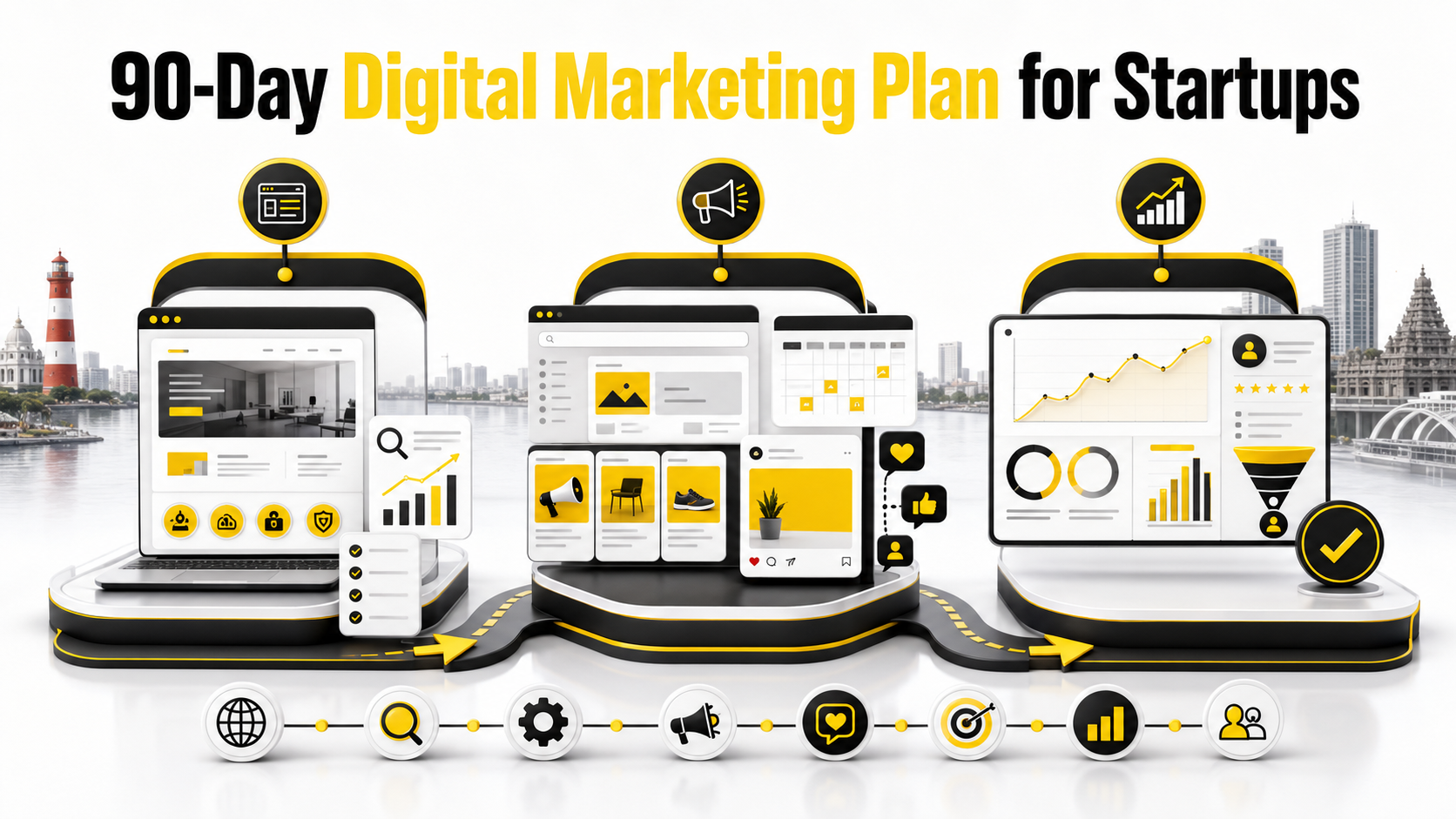
This 90-day digital marketing plan gives Chennai startups a practical framework for building their foundation, testing channels and improving what works.
Before Day One: Define What Marketing Must Achieve
Before selecting marketing channels, decide what the business needs most during the next three months.
Your primary objective could be:
-
Generating qualified sales enquiries
-
Booking product demonstrations
-
Increasing local store visits
-
Growing online purchases
-
Building awareness for a new brand
-
Attracting users for a new application
-
Collecting registrations for an event
Choose one primary objective instead of trying to achieve everything simultaneously.
For example, a Chennai-based B2B software startup may prioritize demo bookings. A new restaurant may focus on local discovery and reservations. An ecommerce startup may concentrate on first-time purchases.
Once the objective is clear, define the action visitors should take on your website. This could be submitting a form, calling the business, sending a WhatsApp message, scheduling a meeting or completing a purchase.
Days 1–30: Build the Marketing Foundation
The first 30 days should focus on getting the essential elements right. Increasing traffic before fixing the foundation can result in wasted advertising spend and missed enquiries.
1. Understand Your Ideal Customer
Create a simple customer profile that answers these questions:
-
Who needs the product or service?
-
What problem are they trying to solve?
-
Where are they located?
-
What influences their buying decision?
-
What questions do they ask before purchasing?
-
Which online platforms do they use?
-
Why might they choose a competitor?
Avoid defining the audience too broadly. “Businesses in Chennai” is not a precise target. “Small retail businesses in Chennai that want to generate orders through WhatsApp” provides much clearer direction.
The better you understand the customer, the easier it becomes to create relevant website content, advertisements and offers.
2. Improve the Website’s Conversion Path
A startup website does not need dozens of pages, but every important page should answer four questions:
-
What does the company offer?
-
Who is it for?
-
Why should the visitor trust the company?
-
What should the visitor do next?
Make sure the website contains clear service or product information, working contact options and a visible call to action.
Test the website on both mobile and desktop. Check whether forms work, phone numbers are clickable and WhatsApp opens the correct conversation. Pages should load quickly enough that visitors do not leave before seeing the offer.
3. Set Up Measurement
Marketing decisions should not depend entirely on likes, follower counts or website traffic.
Set up measurement for actions connected to business growth, such as:
-
Form submissions
-
Phone-number clicks
-
WhatsApp clicks
-
Demo bookings
-
Purchases
-
Newsletter registrations
-
Downloads of important resources
Use Google Analytics and Google Search Console to understand how visitors reach the website and what they do after arriving.
Tracking must be tested before launching a large campaign. If conversions are not recorded correctly, it becomes difficult to identify which marketing channel is producing results.
4. Establish Local Visibility
Startups that serve customers in a specific area should build their local presence early.
Complete the Google Business Profile with the correct business name, category, contact details, working hours, website address and service information. Use genuine business photographs and keep the information consistent across the website and trusted business listings.
Do not create fake reviews or use misleading addresses. A smaller number of authentic customer reviews is more valuable than a suspicious pattern of promotional reviews.
5. Select Two Primary Marketing Channels
Most early-stage startups do not have enough time or budget to manage every channel properly.
Select two primary channels based on how customers search and buy.
For example:
-
SEO and Google Ads for customers who actively search for a solution
-
Instagram and Meta Ads for highly visual consumer products
-
LinkedIn and email outreach for B2B services
-
Local SEO and social media for location-based businesses
The remaining channels can be maintained at a basic level until the startup has enough data and resources to expand.
Days 31–60: Build Visibility and Test Demand
Once the foundation is ready, the next 30 days should be used to attract relevant visitors and test the startup’s assumptions.
1. Create Content Around Customer Questions
Start with topics that potential customers research before contacting a business.
Useful content may include:
-
Problem-solving guides
-
Service comparisons
-
Cost and budgeting explanations
-
Checklists
-
Common mistakes
-
Buying guides
-
Frequently asked questions
-
Industry-specific examples
Each article should serve a clear purpose. Avoid publishing short articles simply to increase the total number of pages.
A startup may initially publish one or two strong articles per week. Quality, usefulness and topical relevance are more important than daily publishing.
Link relevant articles to the appropriate service or product pages. This helps visitors move from learning about a problem to understanding the solution offered by the company.
If your team needs coordinated support across search, paid campaigns, content and conversion tracking, review the available digital marketing services in Chennai.
2. Begin SEO with Focused Topics
SEO takes time, particularly for a recently launched website. The first two months should concentrate on building relevance and making the website easy for search engines to understand.
Choose keywords that match the startup’s actual products, customer locations and search intent. Do not repeat the same keyword unnaturally across every heading.
Create a small topic cluster around each important service. A main service page can target commercial intent, while supporting blog articles answer related informational questions.
For example, a service page can explain what the company offers, while blog content covers costs, timelines, comparisons, mistakes and preparation steps.
3. Run a Controlled Google Ads Test
Google Ads can help a startup test search demand more quickly, but it should begin with a controlled campaign.
Start with:
-
One clear conversion goal
-
A limited geographic target
-
Closely related keyword groups
-
Relevant ad copy
-
A dedicated landing page
-
Conversion tracking
-
A negative-keyword list
Avoid placing every product or service inside one campaign. Review actual search terms regularly to identify irrelevant clicks.
Do not change campaign settings every day. Give the campaign enough time to collect meaningful data before making major decisions.
Evaluate qualified enquiries and sales opportunities—not clicks alone.
4. Publish Consistently on One Social Platform
Choose the platform where the target audience is most likely to pay attention.
Create three or four content categories, such as:
-
Educational advice
-
Product or service explanations
-
Customer problems and solutions
-
Behind-the-scenes expertise
-
Case-study insights
-
Frequently asked questions
Consistency matters, but posting more frequently does not automatically improve results. A manageable schedule with useful information is better than daily generic content.
5. Improve Lead Follow-Up
Marketing does not end when a person submits a form.
Decide:
-
Who receives the enquiry?
-
How quickly should the team respond?
-
What questions will qualify the lead?
-
How will follow-ups be recorded?
-
When should an unresponsive prospect be contacted again?
Slow or inconsistent follow-up can make a successful campaign appear ineffective.
Days 61–90: Optimize What Is Working
By the third month, the startup should have enough information to identify early patterns.
The objective is not to scale every channel. It is to concentrate resources on activities that show useful signals.
1. Review Channel Performance
Compare channels using business-focused metrics:
-
Qualified enquiries
-
Cost per qualified lead
-
Conversion rate
-
Customer acquisition cost
-
Revenue or sales opportunities
-
Lead quality
-
Time required to manage the channel
A channel generating many low-quality enquiries may be less valuable than one producing fewer but more relevant prospects.
2. Improve High-Impression SEO Pages
Use Google Search Console to identify pages receiving impressions but limited clicks.
Check whether:
-
The page matches the search query
-
The title communicates a clear benefit
-
The description accurately explains the page
-
Important sections are missing
-
Internal links support the page
-
The page contains outdated information
Avoid changing URLs unnecessarily. Improve the existing page whenever it already serves the correct purpose.
3. Reduce Paid Advertising Waste
Review search terms, device performance, locations, advertising schedules and landing-page conversion rates.
Add genuinely irrelevant searches as negative keywords. Pause weak keyword groups only after collecting enough evidence.
Sometimes a high cost per lead is not caused by advertising alone. The landing page may be unclear, the offer may be weak or the follow-up process may be too slow.
4. Strengthen the Best Landing Pages
Use visitor behaviour and enquiry feedback to improve the pages receiving the most valuable traffic.
Possible improvements include:
-
A clearer opening message
-
More specific service information
-
Better mobile spacing
-
Visible contact options
-
Relevant FAQs
-
Authentic testimonials
-
A simpler form
-
Stronger explanation of the next step
Make one meaningful change at a time where possible. This makes it easier to understand what influenced performance.
5. Prepare the Next 90-Day Plan
At the end of the first 90 days, document:
-
Which channels generated meaningful results
-
Which content topics attracted relevant searches
-
Which offers converted better
-
Which customer segments responded
-
Which activities consumed time without producing useful signals
-
What should be tested during the next quarter
Scale channels supported by evidence. Maintain promising long-term activities such as SEO, even if they have not yet reached their full potential.
Common Mistakes Chennai Startups Should Avoid
Trying Every Platform at Once
Managing SEO, Google Ads, Instagram, Facebook, LinkedIn, YouTube and email simultaneously can reduce the quality of every channel. Begin with the platforms most closely connected to customer behaviour.
Measuring Only Traffic and Followers
Traffic is valuable only when it reaches the right audience and contributes to a business outcome. Track enquiries, conversions and lead quality alongside reach.
Copying Competitors Without Context
A competitor’s marketing strategy may reflect a different audience, budget, offer or stage of growth. Use competitor activity for research, not as a plan to copy directly.
Publishing Thin Content Every Day
A strong article that answers an important customer question can provide more long-term value than multiple superficial posts.
Ignoring Chennai-Specific Customer Behaviour
Location, language preferences, service areas and local buying habits can influence how customers search. Use local context when it genuinely helps the reader, but do not insert “Chennai” unnaturally into every sentence.
Expecting Immediate SEO Results
SEO is a cumulative process involving technical accessibility, content quality, relevance, internal linking, authority and user experience. Early impressions are useful signals, but stable growth generally requires consistent work.
A Practical 90-Day Checklist
Days 1–30
-
Define one primary marketing objective
-
Identify the ideal customer
-
Clarify the main offer
-
Test website contact options
-
Set up analytics and conversions
-
Complete local business information
-
Select two primary marketing channels
Days 31–60
-
Publish useful customer-focused content
-
Build focused SEO topic clusters
-
Test a controlled advertising campaign
-
Maintain one relevant social platform
-
Review search terms and enquiry quality
-
Create a reliable lead-follow-up process
Days 61–90
-
Compare channel performance
-
Improve pages gaining search impressions
-
Reduce advertising waste
-
Optimize important landing pages
-
Strengthen internal links
-
Document lessons
-
Prepare the next quarterly plan
Frequently Asked Questions
Does a startup need to use every digital marketing channel?
No. Most startups should begin with one or two channels that closely match how their customers discover and evaluate solutions. Additional channels can be introduced once the initial system becomes manageable.
Should a startup begin with SEO or Google Ads?
SEO can build long-term organic visibility, while Google Ads can test search demand and generate immediate exposure. The right starting point depends on the startup’s budget, timeline, competition and customer journey. Some businesses can use both with different objectives.
How much should a Chennai startup spend on digital marketing?
There is no universal budget. The amount should reflect the business model, customer value, competition and chosen channels. Begin with a controlled budget that is large enough to collect useful data without placing the business under financial pressure.
Can a startup get meaningful results within 90 days?
A startup can build a strong foundation, gather customer data and identify promising channels within 90 days. However, outcomes vary by industry and competition. SEO growth in particular should be evaluated as a longer-term process rather than an immediate guarantee.
Should marketing be handled internally or by an agency?
An internal team may have deeper day-to-day product knowledge, while an agency can provide specialized capabilities across multiple channels. The best option depends on available skills, time, budget and the complexity of the marketing plan.
Final Thoughts
The first 90 days of startup marketing should create clarity—not just activity.
Start with a defined goal, a clear customer profile, accurate tracking and a website that makes the next action easy. Test a limited number of channels, study the quality of the responses and improve the activities supported by real evidence.
A structured approach helps Chennai startups avoid scattered spending and build a marketing system that can be refined as the business grows.